


ExpatronusExpatronus
Клиентам
Поставщикам услугКонтакты
Войти
Услуги в Испании
Всегда бесплатно для экспатов

Специалисты платят небольшую комиссию только когда вы их нанимаете. Никаких скрытых платежей, подписок или подвохов.

Главная / Блог Expatronus / autónomo Spain

autónomo Spain

Do I Need to Register as Autónomo in Spain for Occasional Freelance Income?

A few freelance jobs do not make you autónomo by themselves. Whether you need a RETA alta depends on whether the work is habitual, which is judged case by case. Here is who decides, how the two registrations differ and what to bring to a gestor or tax advisor.

Expatronus Team9 October 20269 мин. на чтение

A woman in her fifties in a green cardigan holding a mug of tea, beside the words: A few freelance jobs. Do you need to be autónomo?

Whether occasional freelance work needs a RETA alta depends on whether it counts as habitual, judged case by case. A gestor or tax advisor on Expatronus can assess yours. Updated October 2026.

This guide is for anyone in Spain who earns a little on the side: a translation here, a logo there, a weekend of catering, a few months of remote work for a client abroad. By the end you will know which office asks which question, why there is no simple income line, and what to put in front of a specialist so the answer you get is about your case and not about someone else's.

What does "habitual" mean for autónomo registration in Spain?

Spain's self-employment statute, the Estatuto del Trabajo Autónomo (Ley 20/2007), describes a self-employed worker as someone who carries out an economic or professional activity for profit, habitually, personally and directly, on their own account and outside anyone else's direction. The word that does the work for occasional earners is the first one: habitualidad, whether the activity is regular enough to count as a working activity at all.
What surprises most people is that neither the statute nor the rules of the self-employed scheme, the Régimen Especial de Trabajadores Autónomos (RETA), say how much activity is enough. There is no published count of invoices, clients or months that turns a side project into habitual work. That gap is why the same question gets different answers on forums, and why the answer for your situation has to come from someone looking at your facts.

Who decides whether your freelance work counts as habitual?

The RETA is run by the Tesorería General de la Seguridad Social (TGSS). According to the Seguridad Social's own page on RETA registration, it is the self-employed person who asks for their own alta, and the TGSS can also register someone on its own initiative, an alta de oficio, when it finds that a registration was due and was not made.
So in day to day terms, you make the first call, usually with a gestor or tax advisor reading your pattern of work. The administration can take a different view later, and when the two sides disagree, the courts decide. That is where most of the guidance on habitual activity comes from. If you already know you are registering, our guide to autónomo registration covers what comes next.

Is registering with Hacienda the same as the RETA alta?

No. They are two separate procedures with two different bodies, and they answer two different questions.

  • The tax census (Agencia Tributaria). The censo de empresarios, profesionales y retenedores is Hacienda's register of people who carry on a business or a profession. You join it, change your details or leave it with a declaración censal. At the time of writing, the Agencia Tributaria has withdrawn the simplified modelo 037, so census registrations, changes and closures go through the modelo 036.
  • The RETA alta (Seguridad Social). This is your registration in the social security scheme for the self-employed, with the TGSS. Whether it applies is the habitual activity question above.
  • Why it matters. Filing a 036 does not register you with the Seguridad Social, and a RETA alta does not tell Hacienda anything. People who mix the two up often believe they are fully registered when they have only done half of it, or that they owe a RETA alta because they filed a census form.
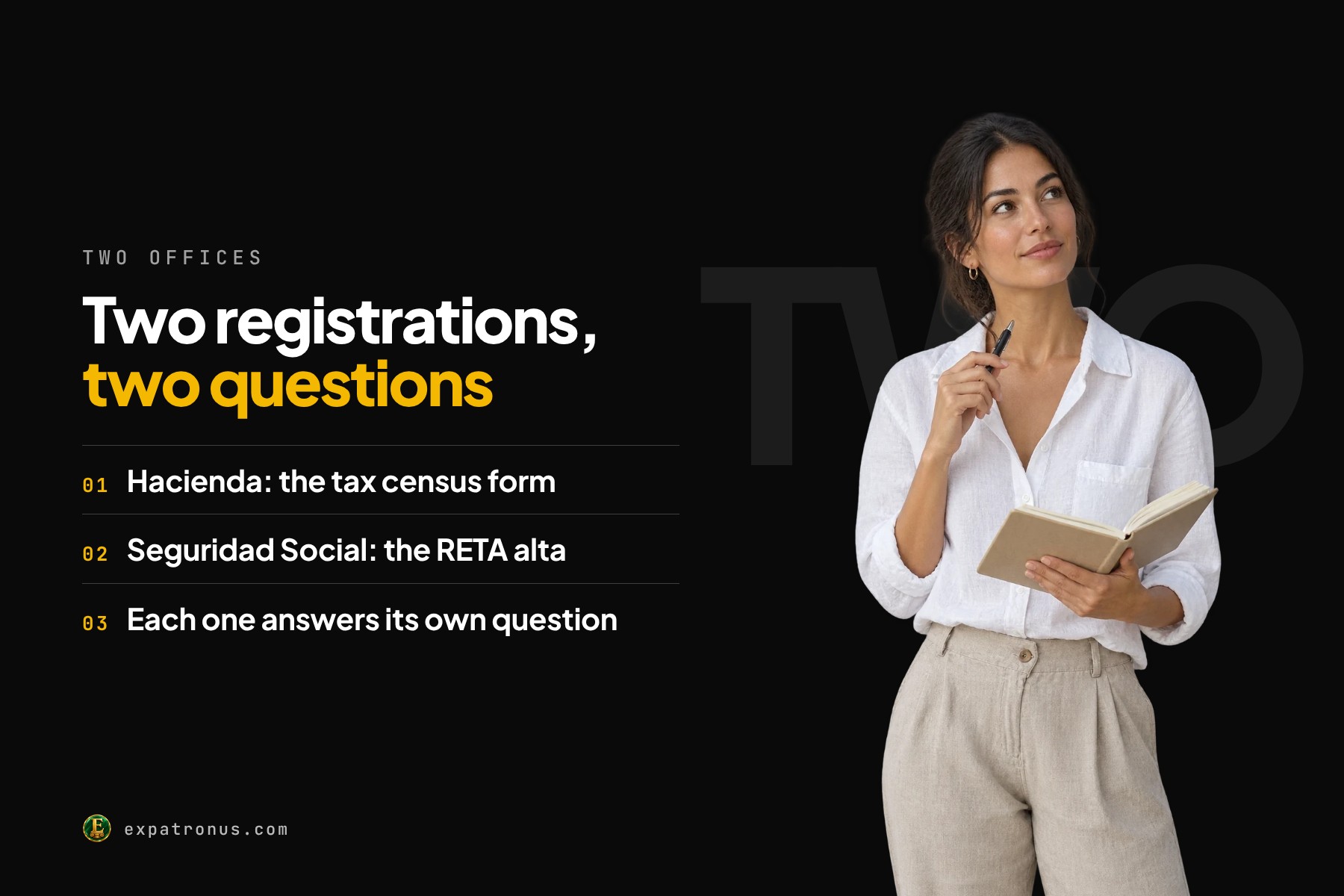
A woman holding an open notebook, beside a list: Hacienda and the tax census form, Seguridad Social and the RETA alta, each one answering its own question
Two registrations, two offices, two questions.

What have Spanish courts said about low or occasional income?

Since a Supreme Court ruling in 1997 about insurance subagents, Spanish courts have used a comparison between what a person earns from the activity and the national minimum wage, the Salario Mínimo Interprofesional (SMI), as one clue to whether work is habitual. Many guides still present that comparison as the rule. The courts have described it as an indicator, one piece of evidence among several, alongside how continuous, organised and recurring the activity is.
A more recent ruling makes the point sharper. As summarised by the Consejo General de Colegios de Gestores Administrativos, the Supreme Court held in July 2025 (STS 941/2025) that earning below the SMI does not, as a general rule, rule out habitual activity. In plain terms: a low income alone does not settle the question either way. The way you work matters as much as what you earn.

Two situations sit under their own rules and are worth naming to a specialist straight away. People who draw a retirement pension and also work on their own account fall under a separate provision of the general social security law (LGSS, article 213.4). And anyone already registered in another scheme is in a different conversation altogether, covered below.

Can I send an invoice in Spain without being in the RETA?

Invoicing goes with the tax side. Being on Hacienda's census is what puts you in a position to issue a factura for your work. Whether the RETA also applies is the separate habitual activity question, and the answer to one does not decide the other.
How the income from those invoices is declared in your income tax return, as rendimientos de actividades económicas, and whether VAT applies to a given client, are questions for a tax advisor with your invoices in front of them. Be wary of forum workarounds that promise to make the question disappear. They tend to move the problem rather than solve it.

I already have a Spanish employment contract: does side work change anything?

It can. Being in two social security schemes at once, for example employed under the general scheme and self-employed in the RETA, is called pluriactividad, and each scheme has its own registration. Having a job does not answer the habitual activity question for your side work, and it does not make it go away. If your freelance work is regular, ask a specialist how pluriactividad applies to you before you invoice, not after.

I just moved or hold a digital nomad visa: which registration applies to me?

New arrivals often meet this question through their visa. For the digital nomad visa, the Spanish consulate's page explains that self-employed applicants show either registration in the RETA or a social security certificate from their home country, along with a signed statement, a declaración responsable. Which of the two your application relied on shapes what comes next.

If you are not sure which route your file used, an immigration lawyer or a relocation specialist can confirm it from your resolution, and a gestor or tax advisor can then tell you what that means for your invoices and your tax return.

Where do people usually get stuck?

  • Treating income as the whole test. Readers look for a single income line, but the July 2025 ruling says income alone does not settle it.
  • Merging the two registrations. The census form and the RETA alta are filed with different bodies and answer different questions.
  • Following outdated guides. Some articles still describe two census forms, quote old wage figures or carry a fresh "updated" date on old text.
  • Mixed situations. Employees with side work, pensioners and people receiving benefits each sit under different rules.
  • The visa angle. Nomad visa holders are often unsure whether their visa relied on the RETA or on a home country certificate.
  • Workarounds from forums. Invoicing through someone else is offered in place of a straight answer for your own case.

Who handles what: a gestor, a tax advisor, a labour advisor or a lawyer?

For most people asking this question, the first conversation is with a gestor or a tax advisor, not a lawyer. The gestores' national council itself recommends asking a gestor administrativo who knows both social security and tax when an activity is secondary or occasional. Here is how the work usually divides. For how the work splits across a whole move, see who handles which part of your move, and before you choose one, the questions to ask a gestor.
  • Gestor administrativo: the 036, the RETA alta, the digital certificate, routine filings and a first view on whether your work looks habitual.
  • Tax advisor (asesor fiscal): how the income is taxed, invoicing foreign clients, VAT questions and tax residence for new arrivals.
  • Labour advisor (graduado social): social security questions, pluriactividad and replies to letters from the TGSS.
  • Lawyer: disputes, such as challenging an alta de oficio, an inspection or an appeal against a penalty.
  • Immigration lawyer or relocation specialist: which social security route a visa application relied on.

A man in a navy blazer holding a green folder, beside a list: every paid job of the last year, how often new work comes in, your contract, pension or visa
What to put in front of a gestor or tax advisor.

What should I bring to a gestor or tax advisor?

  • A list of every paid job in the last year: the client, the client's country, the dates, the work and how you were paid.
  • The likely pattern from here: one-off or repeat work, how often it comes in, whether you advertise or keep a profile or website, and whether you use your own equipment or premises.
  • Your current status with its papers: an employment contract, a pension, a benefit or your studies.
  • Your residence documents: NIE or TIE, your visa type and its resolution, your padrón certificate and any home country social security certificate.
  • Anything already filed: a 036, your NIF and your digital certificate or Cl@ve access.
  • Any letter from the TGSS, the Agencia Tributaria or the labour inspectorate, and your records of expenses linked to the work.

What should I ask them?

  1. From how I work, would you treat this as habitual, and which facts tip it one way or the other?
  2. Do I need the census registration even if the RETA does not apply, and how is this income declared?
  3. Does the July 2025 Supreme Court ruling change anything in my case?
  4. I am employed, retired or on a digital nomad visa: which rule applies, and do I need a second registration?
  5. If the TGSS or an inspector later disagrees, what happens to past invoices, and what should I keep on file now?
  6. Which steps do you handle yourself, and when would I need a labour advisor or a lawyer?
  7. Do you regularly work with people who invoice foreign clients, and can we work in English?
!
What a specialist confirms for your case: whether your activity is habitual, which registrations apply to you, how the income is declared, and what changes if you are employed, retired or here on a visa. This article explains who decides, and it cannot make that call for you.

Frequently asked questions

Is there an income level below which I never need to register?

No published figure settles it. Courts have used income as one indicator, and in July 2025 the Supreme Court said that earning below the minimum wage does not, as a general rule, rule out habitual activity. A specialist looks at the whole pattern of your work.

Can the Seguridad Social register me without my asking?

Yes. The TGSS can make an alta de oficio when it finds that a registration was due. If that happens to you, a labour advisor or a lawyer can tell you whether and how to challenge it.

Do I need a lawyer to set up as autónomo?

Usually not. A gestor or a tax advisor normally handles the census form and the RETA alta. A lawyer comes in when there is a dispute, an inspection or a penalty to appeal.

Is the modelo 037 still used?

At the time of writing, the Agencia Tributaria has withdrawn the simplified 037, and census registrations, changes and closures use the 036. Older guides that describe both forms are out of date on this point.

Do I need a gestor or a tax advisor?

For the registrations themselves, a gestor is the usual choice. For how the income is taxed, invoicing clients abroad or tax residence, a tax advisor is the better fit. Many people with mixed situations ask one of each, or a firm that offers both.


Not sure where your freelance work falls? Describe your case once and compare independent gestores and tax advisors on Expatronus, then put the questions above to each. Start your case here.
i
Disclaimer: The information in this article is for general informational purposes only and does not constitute legal, tax, or financial advice. Laws and regulations change frequently, so always verify with official sources and consult a qualified professional before making any decisions.
Темыautónomo Spainoccasional freelance incomeRETA altahabitualidadgestor or tax advisoraeo:who-006aeo:who-002

В этой статье

  1. 01What does "habitual" mean for autónomo registration in Spain?
  2. 02Who decides whether your freelance work counts as habitual?
  3. 03Is registering with Hacienda the same as the RETA alta?
  4. 04What have Spanish courts said about low or occasional income?
  5. 05Can I send an invoice in Spain without being in the RETA?
  6. 06I already have a Spanish employment contract: does side work change anything?
  7. 07I just moved or hold a digital nomad visa: which registration applies to me?
  8. 08Where do people usually get stuck?
  9. 09Who handles what: a gestor, a tax advisor, a labour advisor or a lawyer?
  10. 10What should I bring to a gestor or tax advisor?
  11. 11What should I ask them?
  12. 12Frequently asked questions

Нужна помощь с этим?

Расскажите о своём деле и сравните предложения специалистов, которые им занимаются.

Вам также может понравиться

Рекомендуем вам

A smiling woman in a mustard sweater holding a laptop to her chest, in front of a gold ring on a dark green background
moving to Madrid

Moving to Madrid From the UK: Which Professionals Do You Need?

Most UK movers meet a lawyer, a gestor and a tax advisor, each for a different job. Here is who handles what, in what order, and what to bring to the first call.

9 мин. на чтение11 Oct 2026
Читать
A smiling woman in a teal cardigan standing in front of a black box on a yellow background
hoja de encargo

How Do Lawyers in Spain Charge for a Visa Application, and What Should the Hoja de Encargo Say?

A Spanish lawyer sets out the terms of the work in an engagement letter, the hoja de encargo. Here is what the bar's own code says it should cover, the three shapes a fee takes, and the questions to ask before you sign.

9 мин. на чтение10 Oct 2026
Читать
A woman at a sunlit terrace table with a laptop showing an empty calendar, a passport and a coffee, in front of a whitewashed wall with bougainvillea
BLS Spain

Can an Immigration Lawyer Help Me Get a Spanish Visa Appointment When BLS Has No Slots?

A lawyer cannot jump the BLS queue, but can confirm your route, prepare your file and keep a record. Here is who controls the appointment and what to ask a specialist.

9 мин. на чтение9 Oct 2026
Читать

Готовы начать свой путь в Испанию?

Наши эксперты помогут вам на каждом шагу — от выбора визы до обустройства жизни в Испании.

Без обязательств · Банковская карта не нужна · Подбор в течение 48 часов

Связаться с нами
ExpatronusExpatronus

Ответьте на несколько вопросов о вашей ситуации. Получите персонализированную рекомендацию по визе за 30 секунд — затем выберите: следуйте нашему бесплатному руководству ИИ или свяжитесь с проверенным специалистом.

Принимает новых клиентов

Услуги

  • Виза и иммиграция
  • Жильё
  • Банковское дело
  • Налоги и право
  • Школы и образование
  • Переезд и логистика
  • Страхование
  • Открытие бизнеса
  • Смотреть все услуги

Компания

  • Блог
  • Контакты
  • Стать партнёром

Контакты

  • info@expatronus.com

Мы говорим на

ENESRU

© 2026 Expatronus S.L. Все права защищены.

Политика конфиденциальностиУсловия использованияПолитика использования cookie