A gestor can file most of it for you: the tax forms, the request to Tráfico and the plates. The ITV inspection needs the car itself. Expatronus lets you compare gestors. Updated 29 October 2026.
This guide is for anyone who now lives in Spain and still drives the car they brought from home: a retired couple who drove down from Kent, a nurse who came from Bucharest with her hatchback, an American who shipped a pickup to Valencia. It walks through the steps to Spanish plates in the order they happen, what changes when the car comes from outside the EU, which papers to keep, and the part a gestor takes off your hands. It names no taxes, fees or time limits. Those come from the official pages and from the professional who handles your file.
Who has to put a foreign car on Spanish plates?
Until the car carries Spanish plates, it still has to be legal in the country that registered it. That means road tax, any roadworthiness test and insurance in that country stay up to date. So keep the home insurance and road tax paid while you wait for a Tráfico appointment.
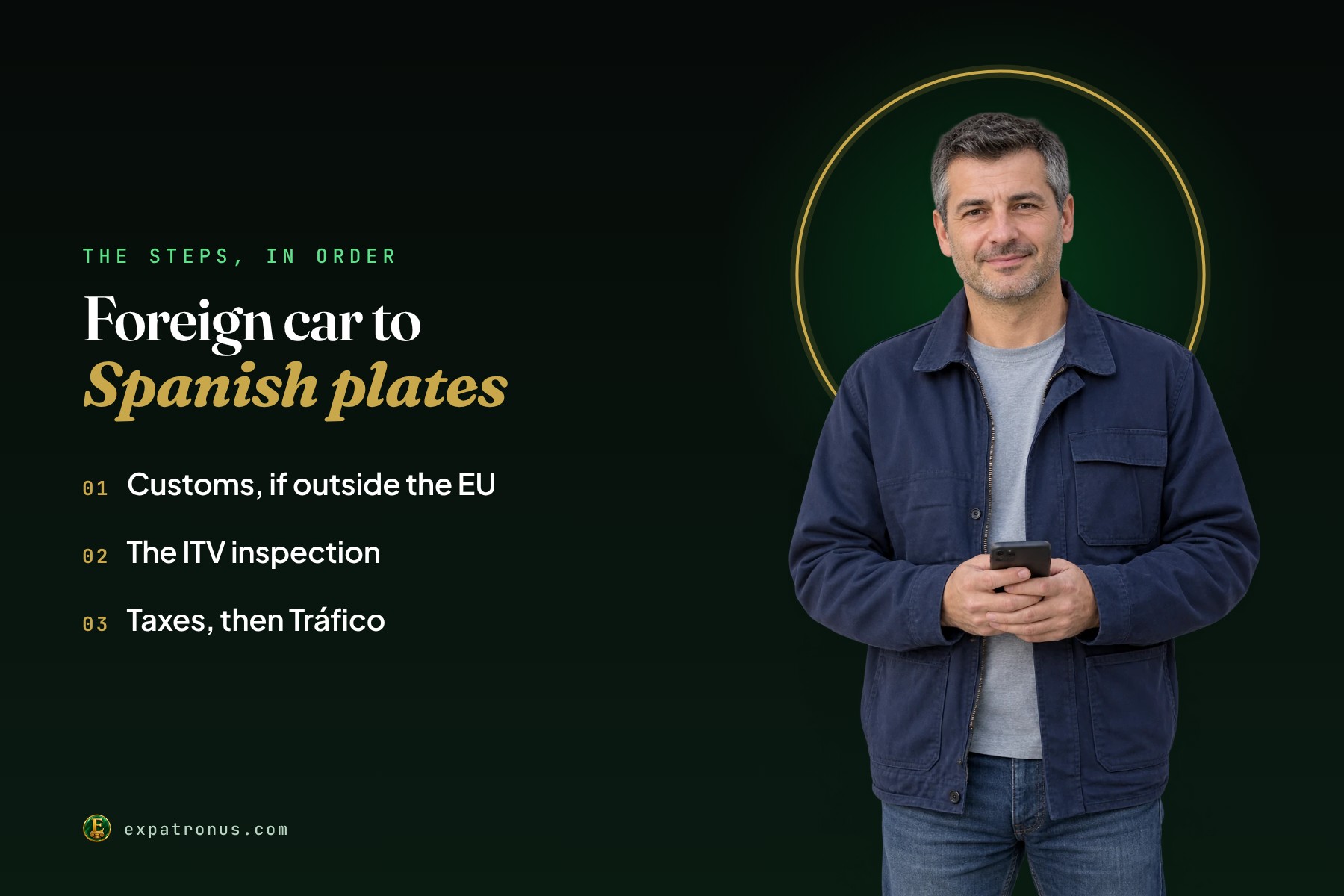
The steps to Spanish plates, in order
The DGT describes one route for a car from another EU country and a longer one for a car from anywhere else. Both end the same way. This is the whole map, with the office at each step and who usually does the work:
- Paperwork at home. For a car from the EU, the DGT says to deregister it for export in its home country before you leave. Who does it: you, with the home registration office.
- Customs (cars from outside the EU only). The car is cleared at Spanish customs and you get the import certificate, the Certificado de Importación H1. Who does it: a customs agent or a gestor who handles imports, with the tax agency.
- The ITV inspection. An authorised ITV station inspects the car and issues its technical card in Spanish format. Who does it: you take the car; a gestor can book it and prepare the papers.
- The registration tax. You file Modelo 576, or Modelo 05 or 06 when an exemption or non liability applies, with the tax agency. Who does it: a gestor or tax advisor.
- The local road tax. The Impuesto de Circulación, or IVTM, is paid to the town hall where you live. Who does it: you or your gestor.
- The request to Tráfico. The DGT registers the car, gives it a number and issues the Spanish registration certificate. Who does it: a gestor online, or you in person with an appointment.
- Plates and insurance. Plates are made at a specialist shop. Then the car is insured on its Spanish number. Who does it: you, with your insurer.
What changes when the car comes from the UK, the US or anywhere outside the EU?
Since Brexit, a car from the United Kingdom is in this group, even if it has crossed into Spain by ferry many times before. Cars from the United States, Canada, Latin America and Asia are in it too.
The second difference is the car itself. A car built for another market may not carry the European certificate the ITV station looks for, and the DGT warns that a car without it can need extra work before it passes. Ask about this before you ship the car.
What does the ITV inspection ask for?
The ITV is the roadworthiness inspection every car in Spain goes through. For a foreign car it does one more job: it produces the technical card in Spanish format that Tráfico needs. The DGT lists what to bring:
- The registration document from the home country (the permiso de circulación).
- Proof that the car is approved for European roads: the European certificate of conformity (CoC), or a short technical sheet signed by an engineer, the ficha reducida.
- The purchase contract or invoice, if the owner on the home document is not you.
Keep the original documents, because the ITV station and Tráfico both ask for them. A car with no CoC needs extra steps, so check for it before you book the inspection.
Which taxes come into it, and what is the change of residence exemption?
For people moving here, the exemption to ask about is for a car brought to Spain because its owner moved their usual home here. It is set out in the excise law (Ley 38/1992, article 66.1.n) and comes with conditions about the owner and the car. Whether you meet them is the question to put to your gestor or tax advisor, with your dates and papers in front of them.
The second tax is the local road tax, the IVTM, paid to the town hall where you live. Tráfico asks for the receipt or the exemption for both.
What can a gestor do for you, and what stays with you?
- Check your papers before anything is booked, and tell you what is missing.
- Book the ITV and say which documents to take on the day.
- File the registration tax form or the exemption request, and the local road tax.
- Send the request to Tráfico and collect the registration certificate.
- Point you to a customs agent when the car comes from outside the EU.
What stays with you: driving the car to the ITV (or arranging for someone to take it), signing the authorisation that lets the gestor act for you, insuring the car on its new number, and anything that happens in your home country, such as deregistering it there.
Questions to ask a gestor before they take the file
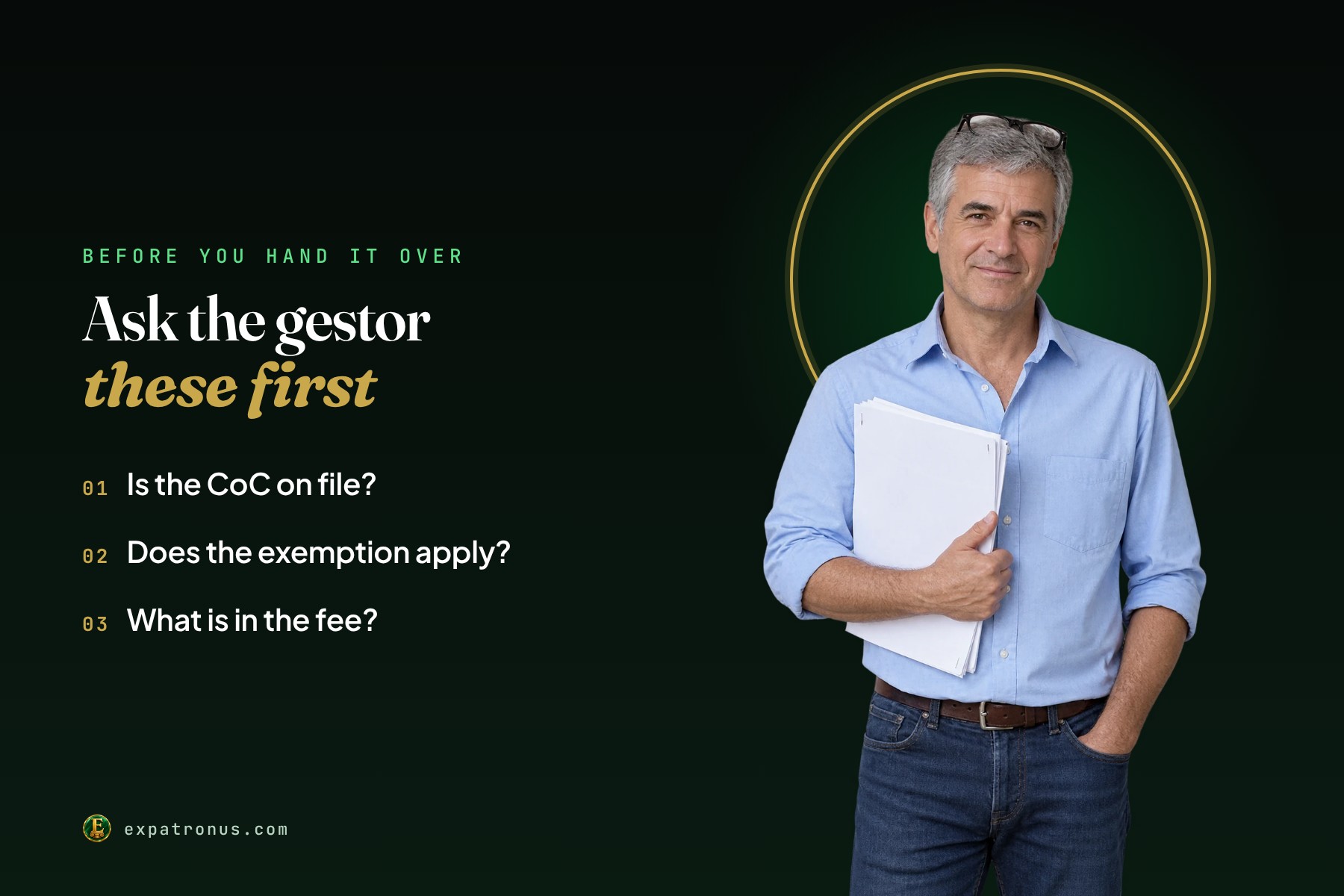
- Have you registered foreign cars from my country before, and how did the last one go?
- Looking at my papers, is anything missing for the ITV, such as the certificate of conformity?
- Does the change of residence exemption apply to me, and what do you need to show it?
- Will you handle customs as well, or should I find a customs agent?
- Do I need temporary plates while this runs, and can I keep driving on my home insurance?
- What is in your fee, and what is paid separately to the tax agency, Tráfico and the town hall?
Can you keep driving while the paperwork runs?
Whichever you use, check with your insurer that the cover still holds for a car kept in Spain by a Spanish resident. That conversation is quicker before the move than after a scrape in a car park.
Bring the car or sell it at home?
Frequently asked questions about putting a foreign car on Spanish plates
Do I have to register my car in Spain if I am only staying a few months?
The DGT ties the duty to residence. Someone visiting does not register the car. Someone who becomes resident does. If you are unsure which you are, ask an immigration lawyer or gestor to look at your situation.
Can a gestor take the car to the ITV for me?
Ask at the first call whether they arrange it or you take the car yourself. The papers around the inspection are work a gestor can do either way.
Is a car from the UK treated as an EU car?
No. The United Kingdom left the EU, so a car from there goes through customs first and follows the DGT steps for cars from outside the EU.
Which form do I file if I think I am exempt from the registration tax?
Modelo 05 or Modelo 06, depending on whether the tax agency has to recognise the exemption first. Your gestor or tax advisor files the right one.
Do I need an NIE to register the car?
The DGT asks for proof of identity, such as a residence card, a Spanish ID or a passport with an NIE, plus proof of your tax address. Have these ready before you book anything.
What happens to my home registration?
For a car from the EU, the DGT says to deregister it for export in its home country. Ask the registration office there how it works, and keep the proof.