An SL takes a notary, a bank, two registries and the tax agency, and a gestor or business lawyer usually runs the file. Compare them on Expatronus. Updated 23 October 2026.
Who is involved in setting up an SL in Spain?
- Registro Mercantil Central: certifies that your company name is free, the certificación negativa de denominación.
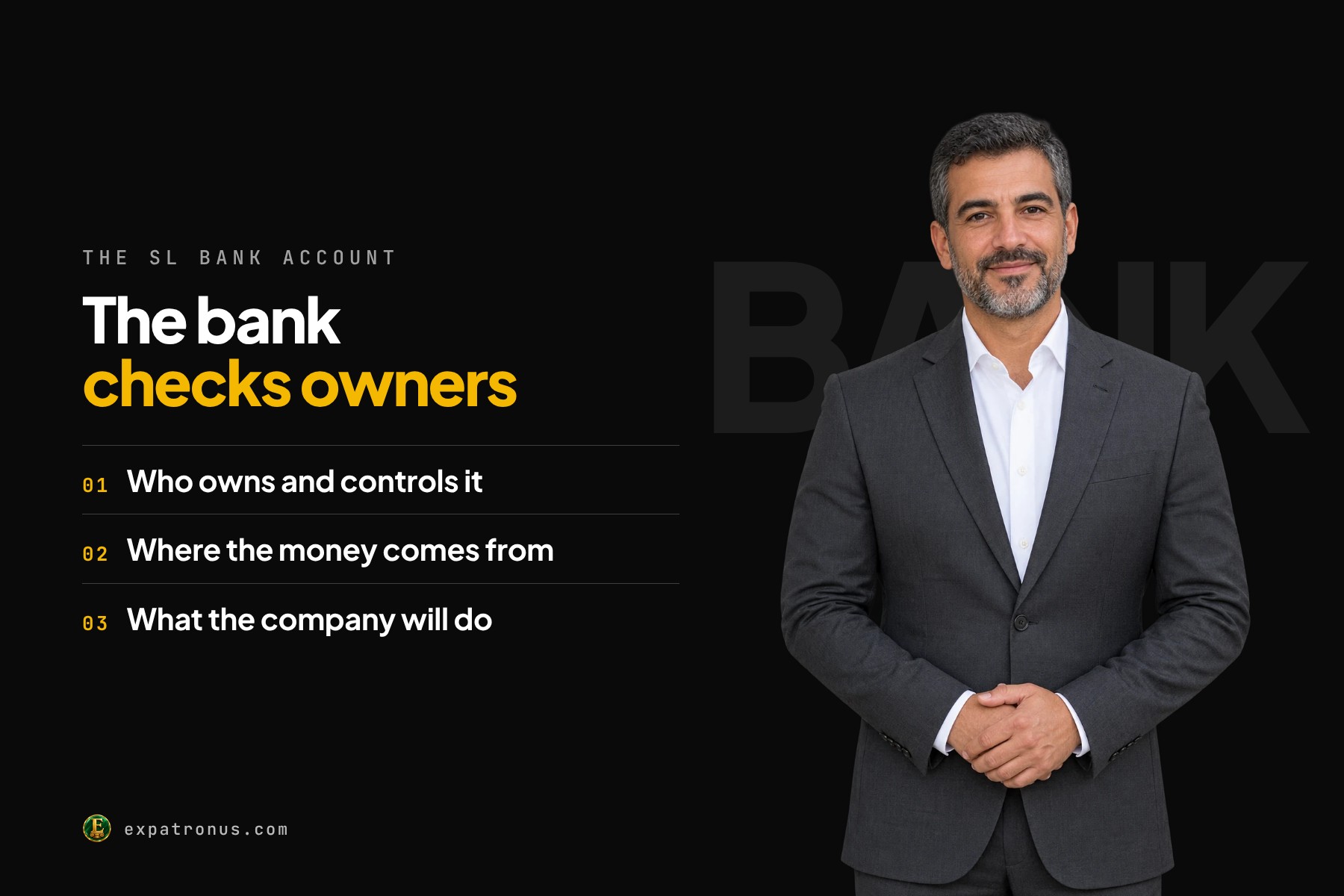
- The bank: opens the company account, takes the share capital and issues the deposit certificate. It also checks who owns and controls the company.
- The notary: checks identity, capacity and powers, then authorises the deed of incorporation, the escritura de constitución.
- The tax agency (AEAT): issues the company's tax number, the NIF, first provisional and then final, and any NIF a foreign partner needs.
- The provincial Registro Mercantil: registers the company, and from that moment it exists as a legal person.
- A gestor or a business lawyer: not required by law, but in practice the person who prepares the papers, books the steps and keeps them in the right order.
Who does what: gestor, lawyer, notary, bank and tax advisor
Here is what each one usually handles in an SL setup, and what they leave to others. Firms differ, so ask each one what their quote covers.
- Gestor: the name certificate, the tax forms, booking the notary, the steps after registration. Usually not the shareholder agreement or a complex structure.
- Business lawyer: the structure, bylaws beyond the standard model, documents from a foreign parent company, the bank file when it gets difficult. Often works with a gestor for the routine filings.
- Notary: authorises the deed and checks identity and powers. A public official, so the notary does not advise you on which structure suits your plans.
- Bank: the company account, the capital deposit certificate, its own checks on owners and funds. It decides on its own terms whether to open the account.
- Tax advisor: how the company and you as its owner are taxed, and what changes when you live in Spain or abroad. Often the same firm as the gestor, sometimes not.
- Sworn translator and the apostille office in your home country: official translations of foreign papers, and the apostille or legalisation that makes them valid here.

What do you need from home before you start?
- Your NIE, the foreigner's identity number, if you are a founder or director as a person. From abroad it is requested at the Spanish consulate for your area. Our NIE guide covers what it does and does not give you.
- A Spanish NIF for a foreign company, if a company you own abroad is the shareholder. The ICEX guide says it is requested on the census form, the modelo 036, and that the foreign company's legal representatives need a Spanish tax number too.
- Proof that a foreign parent company exists, such as its registry certificate or bylaws, with a sworn Spanish translation and an apostille, or legalisation through the consulate if your country is outside the Hague Convention.
- A power of attorney if someone will sign at the notary for you, with the same translation and apostille.
- An ownership chart down to the people who ultimately own or control the company, with their ID.
The steps in order, from the company name to the registry
This is the route on paper, as the ICEX guide sets it out. A gestor or lawyer can do most of it for you, but the order stays the same.
- Tax numbers for every foreign partner. The NIE for people, a NIF for a foreign company.
- The name certificate. The Registro Mercantil Central confirms that no other company is registered under the same name.
- The provisional NIF of the new company, on the census form at the tax agency.
- The bank account in the company's name, the capital paid in and the bank's deposit certificate.
- The bylaws, the estatutos: the name, what the company does, its registered address, the capital and shares, and how it is run.
- The deed at the notary, signed by every founder in person or through someone holding their power of attorney.
- The transfer tax form. Forming a company is exempt, but the ICEX guide says a form claiming the exemption still goes to the regional tax office before the registry accepts the deed.
- Registration at the provincial Registro Mercantil, where the company becomes a legal person and is published in the official registry gazette, the BORME.
- The final NIF, exchanged for the provisional one with the deed, the bylaws and the registry certificate.
- The foreign investment declaration to the Registro de Inversiones, an information form. The ICEX guide notes that the notary can file it for you.
Starting work brings its own registrations: the activity census at the tax agency, and the Social Security employer account before you hire anyone. Your gestor usually lines these up with the last registry steps.
Can you set up an SL online from abroad?
Partly, and sometimes fully. There are two online routes, and a gestor or lawyer can tell you which one fits your case.
The second is the fully online SL. Since a 2023 reform (Ley 11/2023), article 22 bis of the Ley de Sociedades de Capital allows an SL to be formed entirely online, and only when every contribution is money. Garrigues explains that the deed is signed before a notary by video, and that the notary may still ask you to appear in person once to confirm who you are.
How much capital does an SL need?
The answer changed in 2022. The Ley 18/2022, known as the Crea y Crece law, rewrote the minimum capital rule for SLs, and English guides written before it still quote the old figure. How much capital your company should hold is a business and tax decision as much as a legal one. Ask your gestor or lawyer what the rule is today and what your bank and suppliers will expect, then decide with them.
Why is the bank account often the slowest step?
Do you also need a visa or residence to run an SL?
Red flags when you hire help for an SL setup
- A fixed promise that the company will be ready in a day or two, before anyone has seen your foreign papers.
- An offer to put the shares in someone else's name to make the bank easier. The bank checks who really owns the company.
- A quote that says nothing about what happens after registration, such as the final NIF, the foreign investment form or the bookkeeping.
- Nobody can tell you who signs at the notary, or whether your power of attorney needs an apostille.
- Pressure to pick a capital amount without asking what the company will do.
Questions to ask a gestor or business lawyer before you hire them
- Which steps does your quote cover, from the name certificate to the final NIF?
- Which documents from my country need an apostille and a sworn translation, and who orders them?
- Can we use the online route, and will I need to come to Spain to sign?
- Which bank do you suggest for a foreign owned SL, and what will they ask me for?
- Who files the foreign investment declaration and the registrations after the company exists?
- Who keeps the books and files the company's tax returns once it trades, and is that a separate quote?
- Do I need an immigration lawyer as well for my own residence?
Frequently asked questions about setting up an SL in Spain
Can a foreigner own all of a Spanish SL?
Do I need a gestor or a lawyer to set up an SL?
Neither is required by law. Most foreign founders use one because the steps involve several offices in Spanish and some papers from abroad. A gestor fits a standard company, and a lawyer fits a foreign parent company, several partners or a difficult bank file.
Do I have to travel to Spain to sign at the notary?
Not always. Someone can sign for you with a power of attorney, and since the 2023 reform an SL formed with money only can be set up online with the notary by video. The notary can still ask you to appear in person once.
What is the certificación negativa de denominación?
It is the certificate from the Registro Mercantil Central that no other company is registered under the name you want. The notary needs it before signing the deed.
When does the company exist?
When the provincial Registro Mercantil registers the deed. Company law says the SL takes on its legal personality at registration, not at the notary.