
ExpatronusExpatronus
ExpatronusExpatronusCreado por expats, para expats
Para Clientes
Para Proveedores
Iniciar sesión
Servicios en España
Siempre gratis para expatriados

Los especialistas pagan una pequeña comisión solo cuando los contratas. Sin costes ocultos, sin suscripción, sin letra pequeña.

Herramientas gratuitasPlanifica tu mudanza tú mismo, gratis y sin registro.
Atlas de visados de EuropaCada país de la UE con sus visados, ciudades y webs oficialesPlan de mudanzaBarrios, costes y primeros pasos en tu ciudadPlanificador de visadosNómada, altamente cualificado o no lucrativo, uno al lado del otroPlanificador de NIE y padrónEl formulario, la tasa y la opción que elegir en cita previaEsperas de cita previaCuánto esperó la gente por una cita en tu provinciaComprobador de carnéSi España canjea tu carné, y los pasos
Inicio / Blog de Expatronus / moving to Spain

moving to Spain

What Should You Ask a Tax Advisor Before Moving to Spain Around the New Year?

Spain looks at tax residence one calendar year at a time, so landing in late December or early January can change which year your income falls into. Who answers that for your case, what to bring and what to ask.

Expatronus Team21 October 20269 min de lectura

A man in his early thirties with sandy hair and a light beard, an olive overshirt over a white tee, holding a phone and a laptop sleeve, in front of a gold ring on a dark green background

Moving to Spain in December or January? Spain sets tax residence by calendar year, so your arrival date matters. Ask a tax advisor first and compare them on Expatronus. Updated 21 October 2026.

This guide is for anyone planning to land in Spain in the weeks either side of New Year: a remote worker starting a nomad visa, an employee whose new job begins in January, a retiree selling a home before the move. It explains why the date on your flight can change which year Spain treats you as resident, which income that touches, who answers the question for your case, and what to ask on the first call. It gives no day counts, rates or limits. A tax advisor reads those against your own dates.

Why does your arrival date matter for tax in Spain?

Spain's tax agency, the Agencia Tributaria, looks at residence one calendar year at a time, from January to December. For each year it decides whether you were a tax resident in Spain, and that answer sets which return you file here and what it has to cover.

That is why the weeks around New Year need care. Land on one side of 1 January and your first resident year may be the year that is about to end. Land on the other side and it may be the next one. Which side counts for you depends on the tests below, on your own dates, and sometimes on a treaty with the country you are leaving.

What decides your first resident year in Spain?

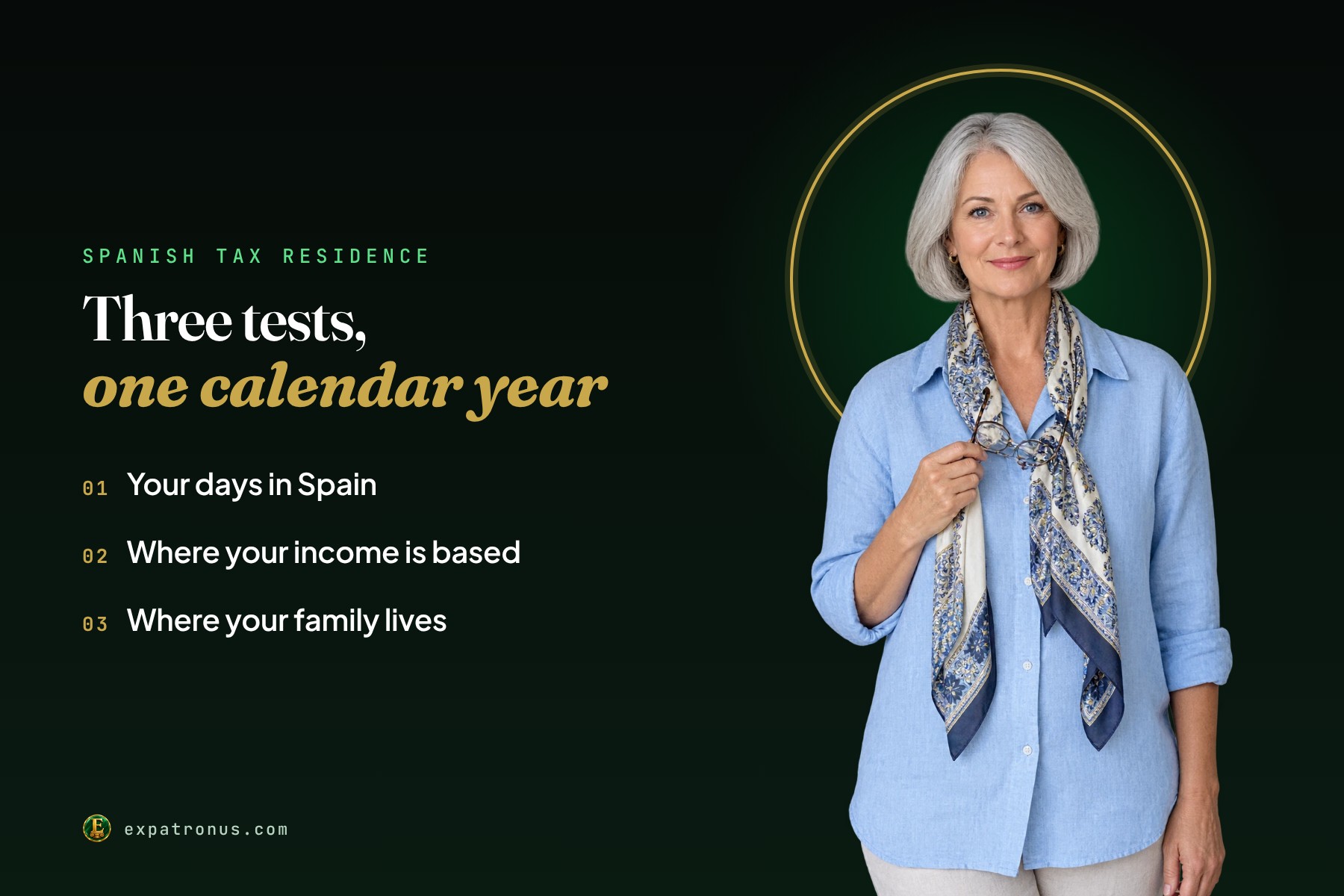
The tax agency's practical guide to income tax sets out the tests, and meeting one of them is enough. At the time of writing they look at three things.
  • How long you stay in Spain during the calendar year. Short trips away still count as days here, unless you can show you were tax resident in another country.
  • Where your economic interests sit. If the main base of your work or your investments is in Spain, you can be resident with fewer days here.
  • Where your family lives. If your spouse and your dependent children live in Spain, the agency presumes you live here too, unless you prove otherwise.

The same guide says your stay is judged on what can be shown, whatever you meant to do. Plane tickets, a rental contract, payslips and a school enrolment are the kind of records a tax advisor will ask to see.
!
Your family's move can count before yours. If your partner and children settle in Spain in the autumn and you follow in January, ask the advisor how the family test reads your case before you book your own flight.
A woman in her sixties with a silver bob and a patterned scarf beside the words Spanish tax residence: three tests, one calendar year. Your days in Spain, where your income is based, where your family lives

Which income can land in your first Spanish year?

Cross border tax advisers writing in October 2026, Skybound Wealth among them, make the same point. Spain does not split the year at the day you arrive, so in a year that counts as resident, income from before you landed can end up in your Spanish return. The items they name most often are these.
  • A salary or a bonus paid by your employer at home
  • The sale of a home, shares or a business
  • A pension payment, or a lump sum taken from a pension
  • Rent from a property you keep abroad
  • Interest and dividends from savings at home

Whether a sale or a payment sits better before or after New Year depends on how your home country taxes it, on the treaty between the two countries and on figures this guide does not state. Those are questions to put to an advisor while your dates can still move.

Does a tax treaty change which year counts?

It can. Spain has double taxation agreements with most of the countries people move from, the United Kingdom among them. When two countries both treat you as resident in the same year, the treaty between them has rules to settle it. Ask the advisor which treaty applies to you and how its rules read your dates.

Your home country also has its own rules for the year you leave, and they do not always line up with Spain's. The advisor in Spain will often want to hear from an advisor there, or at least see what you file at home for that year.

Who answers the arrival date question for your case?

The question is about tax, so the person who answers it is a tax advisor, an asesor fiscal, who works with people moving to Spain. Other professionals play a part. The list shows who usually does what.
  • Tax advisor (asesor fiscal): reads your dates and your income for both years, tells you which year is likely to be your first resident year, how the treaty applies and what each return will need. This is the person for the question in the title.
  • Gestor or gestoría: files registrations and forms with the tax agency and often prepares yearly returns for straightforward cases. Ask whether they handle residence across two countries or pass it to a tax advisor.
  • Immigration lawyer: handles the visa or residence permit. A permit and tax residence follow different rules, and the lawyer can tell you how the date on your permit and your travel plans fit together.
  • Advisor in your home country: covers the tax there for the year you leave, including anything you file on departure.
If you are choosing a tax advisor for the first time, our post on what to check in an English-speaking tax advisor covers the registers and credentials to look for.

What to bring to the first call with a tax advisor

A first call goes further when the advisor can see both years at once. Put these together before you book it.

  • Your planned arrival date, and the dates of any stays in Spain earlier in the year
  • Where your partner and children will live, and from when
  • Your expected income for this year and next: salary, freelance work, pension, rent, savings
  • Anything large you plan to sell or receive, with the rough timing
  • The country you are leaving and your tax status there today
  • Your visa or residence permit if you already have one, with its date
  • Any letter from your employer about where and when you start work

Questions to ask a tax advisor before you pick your arrival date

  1. Given my dates, which year is likely to be my first tax resident year in Spain?
  2. Could my family's move, or my work, make me resident before I arrive myself?
  3. Which of my income from before the move could fall into a Spanish return?
  4. Is there anything I should sell, receive or set up before I become resident, or after?
  5. Which treaty applies to me, and how does it settle the year I move?
  6. What do I file in each country for the year I leave and the year I arrive, and who files it?
  7. Do I need to report bank accounts, pensions or property I keep abroad?
  8. Could the special regime for people who move for work apply to me, and when would I apply?
  9. What records should I keep from now on to show where I was?
  10. How do you set out your fees for this first call and for the returns that follow?
The special regime in question eight is the one known as the Beckham Law. Our post on who helps with the Beckham Law application explains who files it and when it comes up.

Where people moving around New Year usually get stuck

The most common trap is booking first and asking later. Flights, a flat and a start date get fixed in November, and the tax question comes up in spring, when nothing about the year can change.

The second is treating the day count as the whole rule. The family test and the economic interests test can make someone resident in a year they barely spent in Spain, and short trips away can still count as days here.

The third is assuming both countries see the year the same way. Each one applies its own rules to the year you move. The treaty settles the overlap, but someone has to apply it to your dates, and that is easier when the advisors in both countries see the same calendar.

i
What a specialist confirms for your case: the day count Spain uses, how short trips are counted, which year is your first resident year, how the treaty reads your dates, which returns you file and any time limits for them. This guide states none of them on purpose, because they depend on your dates and on the rules in force when you move.
A tax advisor in a camel sweater holding a tablet beside the words Before you book flights: ask a tax advisor which year counts. Bring dates for both years, list big sales and payments, ask which treaty applies

How do you tell the tax agency you now live in Spain?

Once you are settled, your Spanish tax address goes on file with the tax agency. For most people who are not self-employed that is done with Form 030, which also records changes to your tax residence. Self-employed people use the business census forms instead. A gestor or a tax advisor can file it with you and tell you where it fits in your timeline.

Frequently asked questions about moving to Spain around New Year

If I land in late December, am I a Spanish tax resident for that year?

Not because of the date alone. The tax agency looks at your days in Spain across the year, where your economic interests sit and where your family lives. A tax advisor can tell you how those read for your case.

Does my visa decide when I become tax resident?

A visa or permit lets you live in Spain. Tax residence follows the tax agency's own tests, so an advisor will look at the date on your permit and your travel dates together.

Do trips back home count as days outside Spain?

Not always. The tax agency's guide counts short absences as days in Spain unless you can show tax residence in another country. Keep travel records from the start.

My partner moves first and I follow later. Does that matter?

It can. Where your spouse and dependent children live is one of the tests, and it can lead the agency to presume you live in Spain. Ask the advisor before you set the two dates.

Can a gestor answer the arrival date question?

Some can, especially gestorías with tax advisors on staff. Ask whether they handle residence across two countries before you rely on the answer. Our list of questions to ask a gestor helps with that first conversation.

Do I need an advisor in my home country too?

It often helps. Your home country decides how it taxes the year you leave, and the advisor in Spain can work better with that answer in hand.


Compare tax advisors before you book the flights

Describe your move and your dates once on Expatronus and compare estimates from independent tax advisors who work with people moving to Spain. You choose who reads your dates.
i
Disclaimer: The information in this article is for general informational purposes only and does not constitute legal, tax, or financial advice. Laws and regulations change frequently, so always verify with official sources and consult a qualified professional before making any decisions.
Temasmoving to SpainSpanish tax residencetax advisor Spainarrival datemoving in Januaryaeo:cand-tq-2026-10-18-02

En este artículo

  1. 01Why does your arrival date matter for tax in Spain?
  2. 02What decides your first resident year in Spain?
  3. 03Which income can land in your first Spanish year?
  4. 04Does a tax treaty change which year counts?
  5. 05Who answers the arrival date question for your case?
  6. 06What to bring to the first call with a tax advisor
  7. 07Questions to ask a tax advisor before you pick your arrival date
  8. 08Where people moving around New Year usually get stuck
  9. 09How do you tell the tax agency you now live in Spain?
  10. 10Frequently asked questions about moving to Spain around New Year
  11. 11Compare tax advisors before you book the flights

¿Necesitas ayuda con esto?

Cuéntanos tu caso y compara ofertas de especialistas que se ocupan de ello.

También te puede gustar

Recomendado para ti

A woman with a grey bob and round glasses in a grey cardigan, holding a mug, beside the words Your first January as an autónomo: what gets filed
autónomo Spain

First Year as an Autónomo in Spain: What Does My Gestor File in January, and What Do I Hand Over?

Registered as autónomo in Spain this year? What the tax agency's calendar groups in January, what your gestor needs from you in December, the choices for next year, and what to ask before the returns go in.

9 min de lectura26 Nov 2026
Leer
A woman with a long dark braid in a teal cardigan, smiling, beside the words No NIE appointment? Who can help and who to avoid
NIE appointment

Can't Get an NIE Appointment in Spain? Gestor, Lawyer or Consulate: Who Can Help?

No free slot for your NIE? The police issue the number, the appointment costs nothing, and nobody may sell you one. How the booking works, what goes in the file, and when a gestor, an immigration lawyer or a consulate is the right help.

9 min de lectura24 Nov 2026
Leer
A man with sandy hair and a light beard in an olive overshirt, a phone in one hand and a laptop sleeve under his arm, beside the words A requerimiento? Your file is open. Answer each point.
requerimiento

Extranjería Sent Me a Requerimiento Asking for More Documents. What Does It Mean, and Who Can Help Me Answer It?

A requerimiento is a request from the immigration office for papers it still needs, and your file stays open while you answer. What the word means, why offices send one, how it reaches you, how to build the reply and who can prepare it.

9 min de lectura21 Nov 2026
Leer

¿Listo para empezar tu aventura española?

Nuestros expertos te guían en cada paso, desde la selección del visado hasta asentarte en España.

Sin compromiso · Sin tarjeta de crédito · Conexión en 48 horas

Contáctanos
ExpatronusExpatronus

Encuentra y contrata expertos en visados, impuestos, temas legales y vivienda en toda España. Publica tu caso una vez, compara sus ofertas y paga solo a quien elijas. Expatronus está hecho por expatriados, para expatriados.

Acepta nuevos clientes actualmente

Servicios

  • Visado e Inmigración
  • Vivienda
  • Banca
  • Impuestos y Legal
  • Colegios y Educación
  • Mudanza y Logística
  • Seguros
  • Constitución de Empresa
  • Ver todos los servicios

Herramientas gratuitas

  • Atlas de visados de Europa
  • Plan de mudanza
  • Planificador de visados
  • Planificador de NIE y padrón
  • Esperas de cita previa
  • Comprobador de carné

Empresa

  • Blog
  • Contacto
  • Hazte proveedor

Contacto

  • info@expatronus.com

Hablamos

ENESRU

© 2026 Expatronus Todos los derechos reservados.

Política de PrivacidadTérminos de ServicioPolítica de Cookies