
An immigration lawyer reads the refusal and tells you whether to appeal to the consulate or fix the file and apply again. Expatronus lets you compare several. Updated 28 October 2026.
This guide is for anyone who applied for a Spanish visa at a consulate and got a no: a retired teacher from Ohio applying to live on savings, a developer in Lagos with a remote job, a family waiting to join a parent who already works in Madrid. It explains what the refusal letter has to tell you, the two routes it opens, who handles each one, what to gather before you call anyone and the questions to ask a lawyer. Time limits come from your letter and your lawyer, so this page names none.
What does a visa refusal letter have to tell you?
Read the letter for three things before you do anything else: the reason given, the appeals it lists and the date you received it. The date matters because the time to appeal runs from when you were notified, and your lawyer will ask for it first.
Appeal or apply again: the two routes after a refusal
A refusal leaves you three ways forward:
- Appeal to the consulate (recurso de reposición). Filed with the same office that refused you. It asks the consulate to look at its own decision again. Who handles it: usually an immigration lawyer, though the applicant can file it. What it can fix: a refusal that misread the papers you already sent.
- A new application. A fresh file with the gaps closed, at a new appointment. Who handles it: an immigration lawyer for the strategy, with a gestor or sworn translator for the papers. What it can fix: a missing or weak document.
- A court case (recurso contencioso-administrativo). Heard by the High Court of Justice in Madrid. Who handles it: a lawyer and a procurador, a court agent, both required. What it can fix: a refusal the consulate will not change and you believe is wrong in law.
Why the reason on the letter decides the route
An appeal argues against the decision, and the papers you already sent are its evidence. Article 118 of the same law says an appeal does not take into account facts or documents you could have brought earlier and did not. So a refusal because a paper was missing is often easier to answer with a new file than with an appeal.
A refusal that misreads what you did send is different. If the consulate says your health insurance has copayments and the policy you filed has none, or questions a qualification another office already checked, the papers in the file are the argument, and that is what an appeal is for.
Law firms that handle refusals name the same causes again and again: health insurance that is not full private cover, proof of housing that is only a short booking, funds that are hard to read or tied to work, a criminal record certificate without its apostille or sworn translation, and an incomplete file. For the non-lucrative visa, firms reported in 2026 that consulates ask more often for proof that the applicant has stopped working. Which of these applies to you is in your letter, and a lawyer reads it against your file.
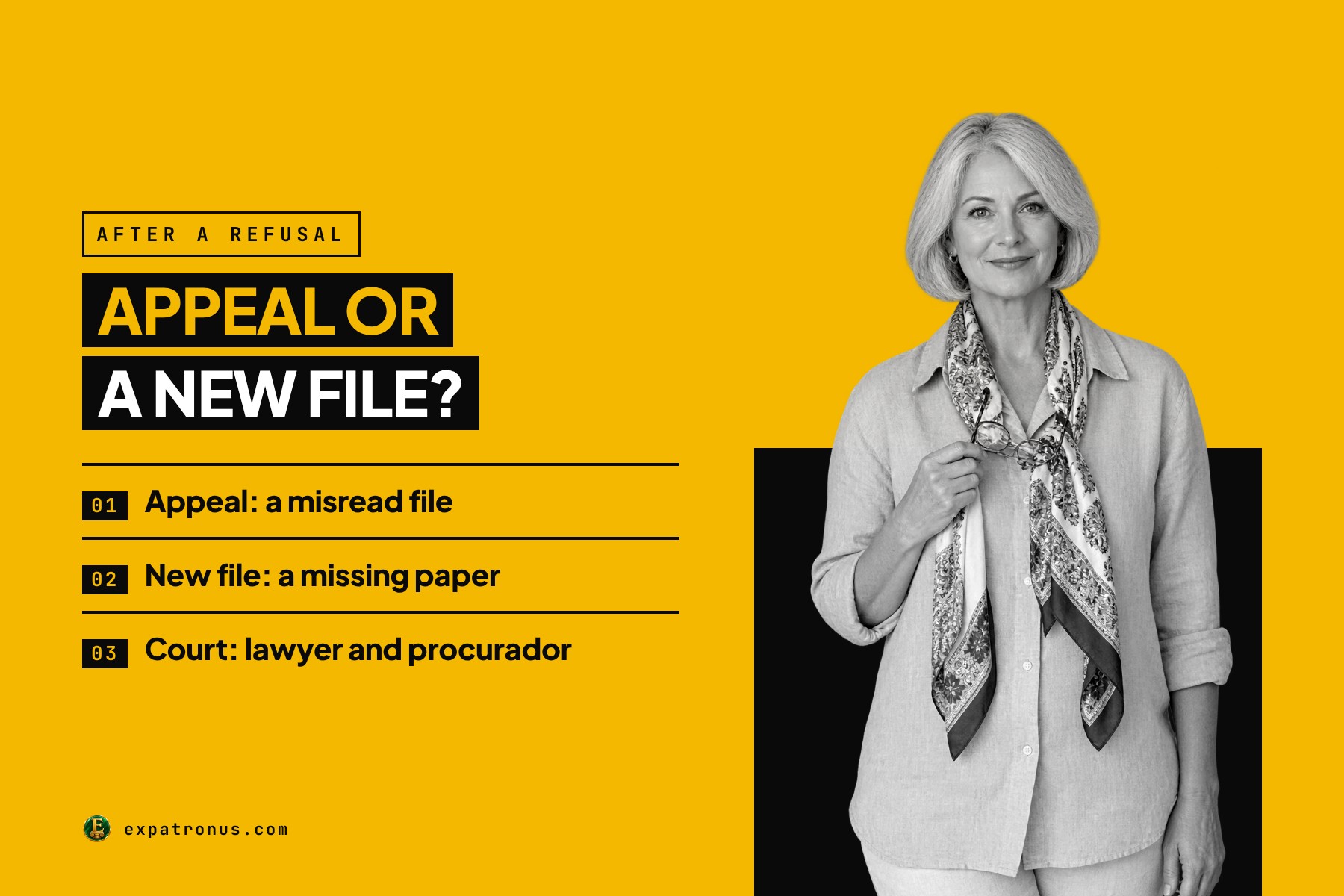
Who handles which part after a refusal?
- Immigration lawyer (abogado de extranjería): reads the refusal against your file, says whether to appeal, apply again or go to court, writes the appeal, and represents you in court. The one to call first.
- Gestor or gestoría: helps gather and order the papers for a new application and books appointments. Useful when the problem was a missing or badly prepared document and the lawyer has already chosen the route.
- Sworn translator (traductor jurado): translates certificates the consulate needs in Spanish, such as a criminal record check or a bank letter.
- Procurador: a court agent who files the case and receives the court's notices. Needed only if the refusal goes to court.
The consulate itself does not advise you on which route to take. It decides both the visa and the appeal.
How do you file an appeal with the consulate?
Each consulate sets its own filing rules, so read the page of the one that refused you. Two examples show how much they differ:
- The consulate in Tangier says the appeal is filed where the visa was applied for, or through the other official channels the law allows, and that an email to the consulate's address does not count as an appeal.
- The consulate in Guayaquil takes appeals in person only, from the applicant or an accredited legal representative, with two copies of the appeal form, the refusal notice and an original identity document.
What to gather before the first call with a lawyer
- The refusal letter, every page, and the date and way you received it.
- A copy of everything you filed: the application form, each certificate, translations and apostilles.
- Any letter the consulate sent before the refusal asking for more papers, and your answer.
- Your appointment confirmation and the file number (número de expediente).
- Your passport, with the dates of any earlier Schengen visas.
- A short note of what you think went wrong and what has changed since you applied.
A lawyer who has the whole file can tell you in the first call whether the refusal reads like a missing paper or a misreading. Without it, the first call goes on working that out.
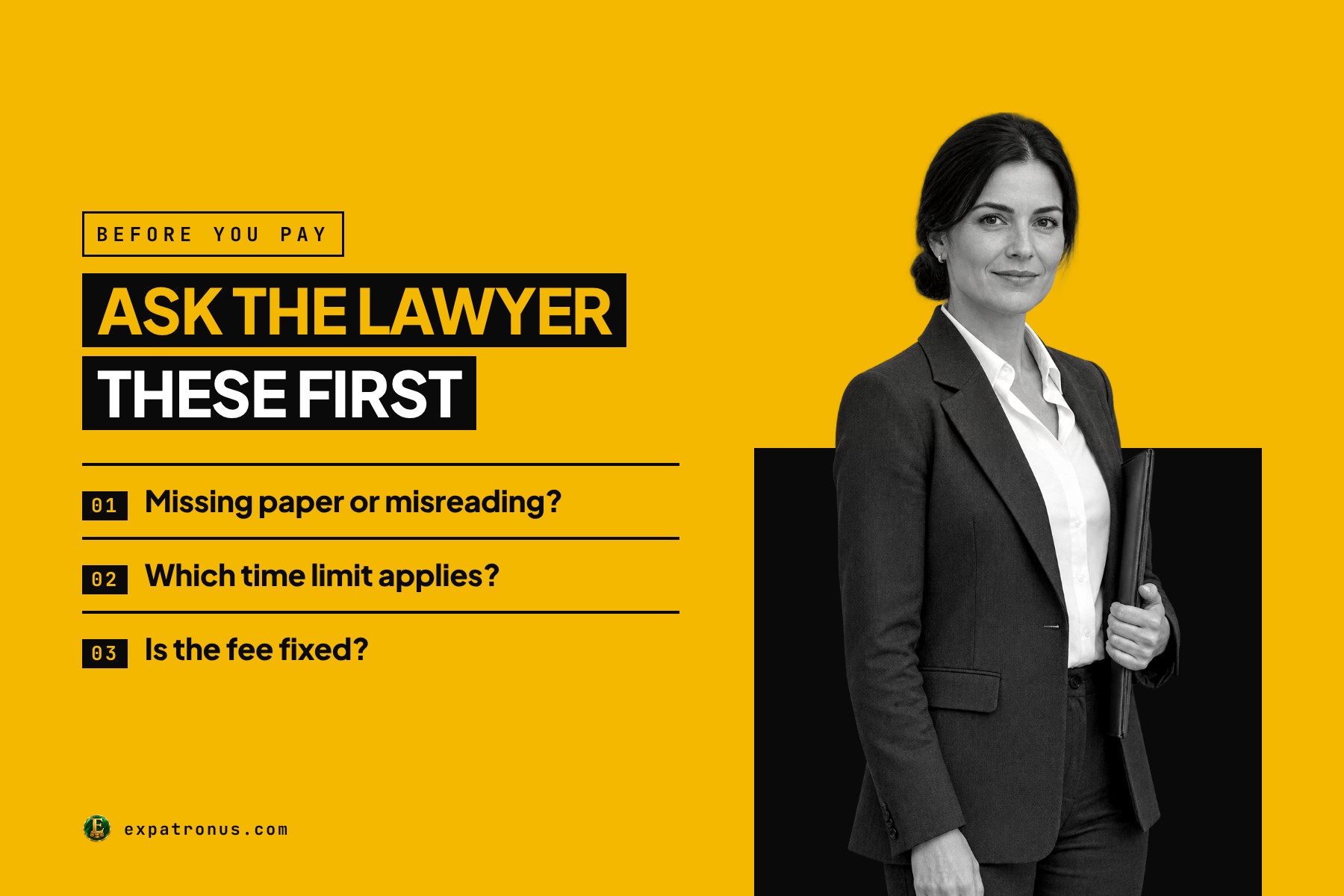
Questions to ask an immigration lawyer after a refusal
- Reading my letter, is this a missing paper or a misreading of what I sent?
- Would you appeal, apply again, or both, and why?
- What is the time limit in my case, and from which day does it run?
- If I appeal, what happens to a new application in the meantime?
- Which documents would you change or add for a new file?
- If it goes to court, do you handle that too, and who acts as procurador?
- Is your fee fixed for this stage, and what does it leave out?
Where people lose time after a refusal
Frequently asked questions about a refused Spanish visa
Can I appeal a Spanish visa refusal myself?
You can file the appeal to the consulate yourself, in Spanish, through the channel the consulate names. Many people still ask a lawyer to write it, because it has to answer the reasons in the letter with the papers already in the file. A court case is different: the law requires a lawyer and a procurador.
Is it better to appeal or to apply again?
It depends on the reason. A refusal for a missing or weak document is often easier to fix with a new file. A refusal that misreads what you sent is what an appeal is for. A lawyer decides this from your letter and your file.
Can I add new documents to an appeal?
Ley 39/2015 says an appeal does not consider facts or documents you could have brought earlier and did not. Ask your lawyer whether a paper you hold now counts as new or as one you could have filed before.
My letter gives no real reason. What can I do?
For some visa types the law requires reasons, and the ombudsman has criticised refusals that use a standard form with no reference to the facts. A lawyer can ask the consulate for the reasons in writing and use their absence in an appeal.
Where does a court case about a visa refusal go?
Cases against consular visa refusals are heard by the administrative chamber of the High Court of Justice in Madrid. You are represented there by a procurador and assisted by a lawyer.
Does a refusal stop me applying for a different visa?
If your situation fits another route better, such as remote work rather than living on savings, ask the lawyer to look at both routes and at how the refusal bears on each before you file again.