It means the office needs more papers before it decides, and your file is still open. An immigration lawyer can help you answer it; compare them on Expatronus. Updated 21 November 2026.
This guide is for anyone who applied for a visa or a residence permit in Spain and then found a letter from Extranjería asking for more documents. It is written for people reading Spanish legal wording for the first time, often weeks after they thought the paperwork was done.
What is a requerimiento from Extranjería?
A law firm guide checked in September 2026 makes a useful point: people call several different letters a requerimiento. One may ask you to complete an incomplete application, another may ask for evidence on a specific point, another may invite you to comment before a decision. Each kind can carry its own rules, so the first job is to read which one you received.
Is a requerimiento a refusal?
No. A requerimiento comes before a decision, and it means your file is still alive. The office is telling you what it needs to keep going. Many people read the formal Spanish, see a legal article quoted, and assume the worst. The letter is closer to a list of missing pieces.
A requerimiento can still end in a refusal if the reply leaves the gap open, so the answer often deserves more care than the first filing did.
Why do offices send a requerimiento?
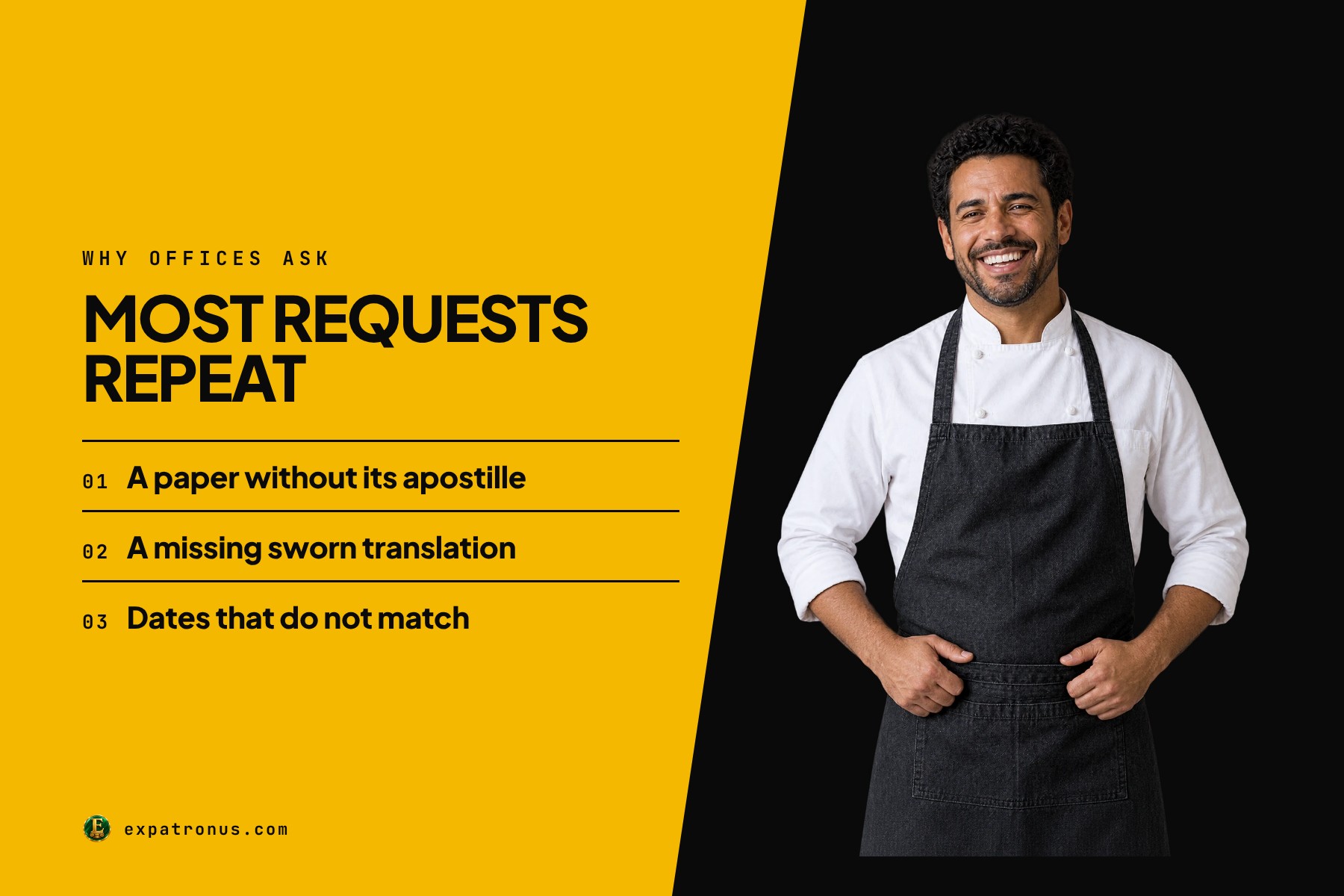
The reasons repeat across files. Three law firm guides from 2025 and 2026 list the same groups of problems:
- Foreign documents in the wrong form. A paper from home without its apostille or legalisation, or without a sworn translation into Spanish.
- A document that is no longer valid. A criminal record certificate or another paper that has expired since you gathered it.
- Papers that do not agree with each other. Dates, addresses or the description of your work that read differently from one document to the next.
- Missing proof for one requirement. Evidence of your ties or your means of support, depending on the permit you asked for.
- A problem with representation. The office could not see that the person who filed for you was authorised to act for you.
Knowing which group your request falls into tells you who should handle it. A missing translation is a matter of gathering papers. A question about whether you meet a requirement is a legal question.
How does the requerimiento reach you?
- Electronically, if you ticked the box agreeing to electronic notifications. The notice is placed in the DEHú, the government's single notifications inbox, or in the Carpeta Ciudadana. You open it with a digital certificate linked to the NIE or DNI of the person named for notifications.
- By post, to the address on the form, if you did not agree to electronic notifications.
An email or a text message is only an alert that something is waiting. The Madrid guide says the notice itself is not sent by email, and having an email address is not enough to receive it. If a gestor or lawyer filed for you, ask whose details sit in the notifications box, because the notice may be waiting in their inbox.
Opening the notice usually matters for when your time to answer starts. A law firm guide on notices advises saving the full notice together with the record of when it was made available and when it was opened.
How do you answer a requerimiento well?
Answer exactly what the letter asks, point by point. The guides we read agree on the shape of a good reply:
- Read the whole notice first and list every point it raises, in its own numbering.
- Match each point to the document that answers it. Give each point its own clearly named file.
- Write a short cover letter, an escrito, with an index: point one, answered by annex one, and so on.
- Where you cannot get a document, say why in the letter and offer the closest evidence you can.
- If the office already has a paper, name when and how you sent it instead of only saying it is in the file.
- Keep the registered receipt of everything you file.
Law firms warn against sending a pile of new papers without explaining how they fit, and against sending the same document again without fixing the problem the office named.
Where do you send the answer?
The Madrid guide lists the routes for its office. You, or anyone acting for you, can file the documents online through the government's electronic office for immigration applications or the general electronic register, both with a digital certificate, Cl@ve or an electronic DNI. In person, the reply can go through a public registry office or through a post office's registry service, addressed to the immigration office handling the file.
Your own notice names the office that sent it and its code. Use those exact details.
Who answers it: you, a gestor or an immigration lawyer?
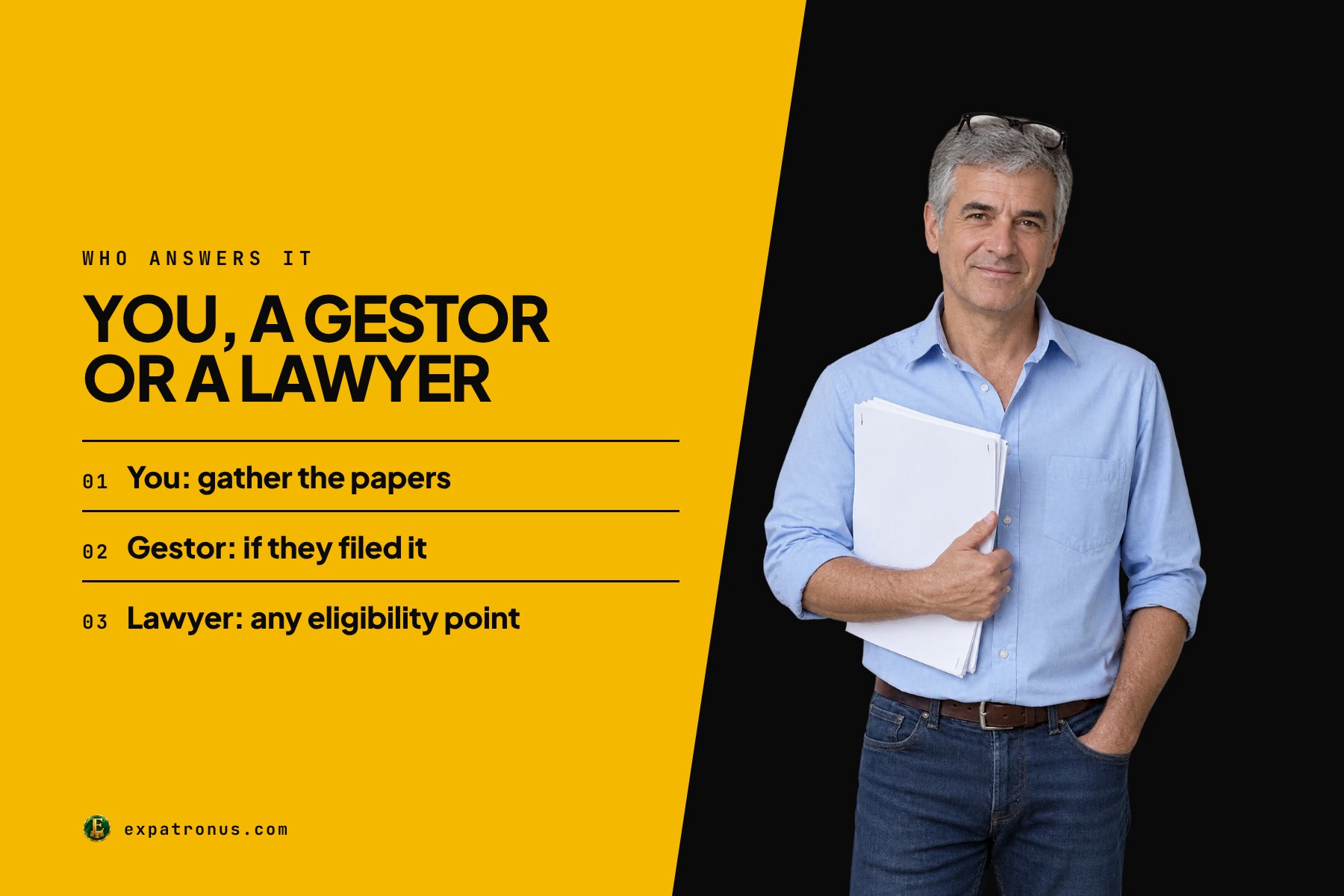
You can answer it yourself, and for a simple missing paper many people do. The Madrid guide says the reply can come from the applicant or from anyone acting on their behalf. In practice the work splits like this:
- Reading the notice and listing each point: you, with an immigration lawyer if any point is about whether you meet a requirement.
- Getting papers from home, apostilled and translated: you, with a sworn translator; the person preparing the reply checks them before filing.
- Writing the cover letter that ties each paper to each point: an immigration lawyer, or the gestor who filed the application.
- Filing the reply online with a digital certificate: whoever represents you, or you with your own certificate.
- A point about your eligibility, an earlier irregular stay or a criminal record: an immigration lawyer.
- A file closed or refused after the request: an immigration lawyer, who looks at what can still be done.
If a gestor or lawyer filed for you, the request may reach them first. Ask them to forward the full notice the day it arrives, and agree in writing who prepares the reply.
What happens if you do not answer?
What to bring to the first call with an immigration lawyer
- The full requerimiento, downloaded from the DEHú or the letter you received, not the alert
- The record showing when the notice was made available and when it was opened
- Your application form and the receipt of the original filing
- Every document you filed the first time, in the same order
- Any paper you already have that answers a point in the notice
- The name of whoever filed for you, if it was not you
Questions to ask before you hire someone to answer it
- Which kind of request is this, and what happens if a point stays unanswered?
- From which day do you count my time to reply, and when will you file?
- Which points are paperwork, and which are about whether I meet a requirement?
- Will you write the cover letter and file the reply in my name?
- Do my foreign documents need a new apostille or a new sworn translation?
- If the office still says no, what would you suggest next?
Ask for the scope of the work in writing before you pay, so the quote says what the reply covers.
Where replies to a requerimiento go wrong
- Waiting for an email. The notice sits in the DEHú or arrives by post. The email is only a reminder, if it comes at all.
- Starting on documents before reading the letter. The office asked for specific things. Read the list before ordering anything from home.
- Forgetting the apostille or the sworn translation. Papers from home in the wrong form are among the most common reasons for a request, and for a second one.
- Answering half the points. One missing point can leave the whole file incomplete.
- Not knowing the notice went to your representative. Ask whose details are in the notifications box on your form.
Comparing specialists for a requerimiento on Expatronus
Frequently asked questions about a requerimiento
Does a requerimiento mean my application will be refused?
No. It comes before the decision and asks for what the office still needs. A clear answer to every point keeps the file moving.
What is the difference between a requerimiento and a subsanación?
A requerimiento is the request. Subsanación is the correction it asks for. A letter called a requerimiento de subsanación asks you to put right a defect or add a missing document.
How long do I have to answer?
The time limit is written on your notice and depends on the kind of request. Ask a lawyer to confirm it and the day it starts, and answer early rather than on the last day.
Can I answer the requerimiento myself?
Yes. The applicant or anyone acting for them can file the reply. A lawyer is worth it when a point is about whether you meet a requirement.
I never got an email. Could there still be a requerimiento?
Yes. Electronic notices wait in the DEHú or the Carpeta Ciudadana, and the email is only an alert. Check there with your digital certificate, or ask the person named for notifications on your form.
Can the office close my file without asking for the missing paper?
Where a correction is possible, the office is expected to ask first. The Ombudsman reminded the Madrid office of this in October 2024.
What if I cannot get one of the documents in time?
Say so in your reply, explain why, and send the closest evidence you have. A lawyer can tell you whether more time can be asked for in your procedure.