
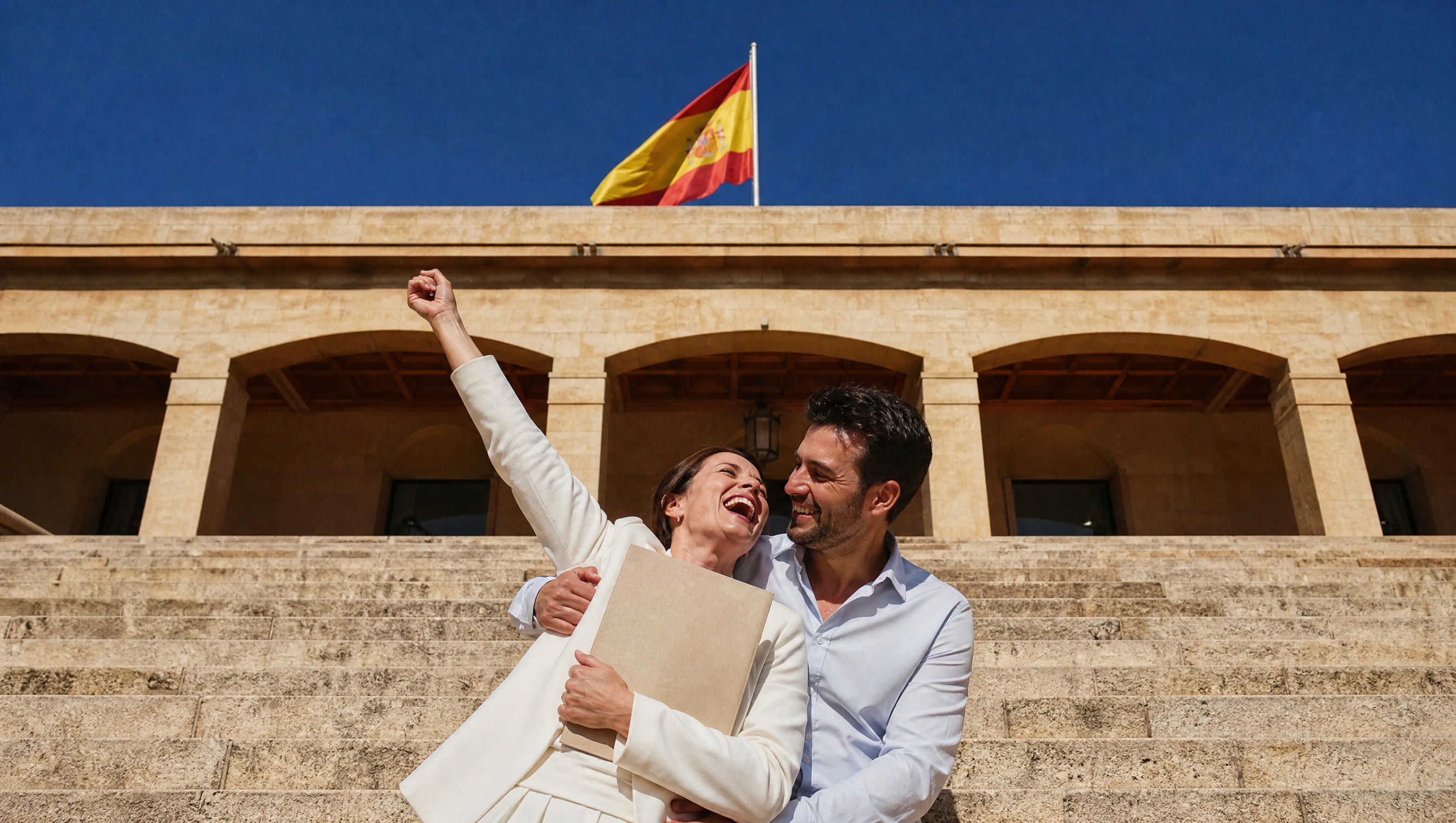
Spanish Citizenship by Residence: Which Clock Applies to You
Expatronus Team2 September 20268 min read
Ten years, five, two or one: the qualifying period for Spanish nationality depends on who you are, not how settled you feel. The four routes, the two exams, and the deadlines at both ends of the file.
Ten years is the number most people have heard, and for a large share of newcomers it is simply the wrong one. Spanish nationality by residence runs on four different clocks, and which one applies to you was mostly decided by where you were born, which passport you hold and who you married, not by how settled you feel. This guide walks through the four residence periods, the two exams the file rests on, what the process really costs, and the two deadlines that catch people out at either end of it.
Four clocks, and only one of them is yours
Article 22 of the Spanish Civil Code sets the qualifying period by category, and the categories are not about integration. They are about nationality, family and place of birth, and between the shortest and the longest there is a factor of ten.
- Ten years. The general rule, and the one that applies to most non EU nationals with no Spanish family link.
- Five years. For people who have been granted refugee status in Spain.
- Two years. For nationals of origin of Ibero American countries, Andorra, the Philippines, Equatorial Guinea or Portugal, and for people of Sephardic origin.
- One year. For a group of birth and family cases, including people born in Spanish territory, people who did not exercise a right to opt for Spanish nationality in time, people who spent two consecutive years under the guardianship or care of a Spanish citizen or institution, someone married to a Spanish national for a year and not separated in law or in fact, the widow or widower of a Spanish national, and people born abroad to a parent or grandparent who was originally Spanish.
The two year route carries a large share of all applications, because it covers most of Latin America. Read the wording closely though: it typically turns on nationality of origin, so a second passport picked up later by naturalisation somewhere else does not usually open that door. The one year marriage route has a trap of its own, since the marriage, the residence and the absence of any separation all have to hold at the moment the file goes in.
Legal, continuous, and immediately before you apply
Whichever clock applies, the Civil Code asks for residence that is legal, continuous and immediately prior to the application, alongside good civic conduct and a sufficient degree of integration into Spanish society. Every one of those words does real work. Legal means time held with a valid residence status, so months spent here before a first permit typically do not count, however long they ran. Continuous means the years join up, which is why a gap between one card expiring and the next being issued can cost far more than the renewal paperwork suggests.
⚠️Long or repeated absences are the quiet killer. There is no single tidy figure that settles it, and the file is weighed as a whole, so a year spent mostly outside Spain is usually a problem even when the residence card stayed valid throughout. The safest reading of the current rules is that Spain should be visibly the centre of your life for the entire qualifying period.
The two exams the file rests on
Applicants of ordinary age and capacity are normally asked for two Instituto Cervantes certificates. The CCSE covers the Constitution and Spanish social and cultural life. The DELE at level A2 covers basic Spanish, and it is the one people worry about most and often do not have to sit at all.
The CCSE is shorter and friendlier than its reputation, and everything on it comes from a published manual that the fee already pays for.
- 25 questions, multiple choice and true or false, drawn from that manual.
- 45 minutes, with 15 correct answers, meaning 60 per cent, needed for an apto.
- EUR 85 worldwide, covering the preparation materials, the certificate and a second attempt if the first sitting does not go well.
- A pass valid for four years from the date the results are approved.
- Exemptions for minors, for people whose legal capacity has been judicially modified, and for holders of Spanish compulsory secondary education.
The DELE A2 runs to about EUR 138 in Spain in 2026, with prices varying by country and examination centre. Nationals of countries where Spanish is an official language are exempt from the language exam, as are minors and people whose capacity has been judicially modified. That exemption covers the language test only, so an applicant from Argentina, Mexico or Equatorial Guinea still sits the CCSE like everyone else.

What it costs before anyone reads the file
The application fee itself is modest. The tasa 790 026 stands at EUR 104.05 at the time of writing, is paid before the file goes in, and is not refunded if the answer is no, because it pays for the processing rather than the outcome. The amount is set by the annual budget law, so it is worth checking the Ministry of Justice site on the day you pay rather than trusting a figure from a forum. Around that sit the real costs: the two exams, criminal record certificates from Spain and usually from every country you have lived in recently, apostilles, sworn translations into Spanish, and a birth certificate that also needs legalising. Nearly all of the money, and almost all of the waiting, lives in that second group.
One year to answer, and a silence that means no
The procedure regulation, Royal Decree 1004/2015, gives the Ministry of Justice a maximum of one year to resolve the application and notify the decision. When that year passes with nothing, the file counts in law as rejected by administrative silence. In practice that is less alarming than it sounds, since most files quietly carry on being processed inside the ministry, and applicants who have waited well past the deadline can generally use the silence to go to the Audiencia Nacional and force a decision.
💡Waits reported through 2026 sit at roughly 12 to 24 months, depending on where the file lands and how complete it arrived. Keep renewing your residence card the whole time you are waiting. A pending nationality application does not preserve your status by itself, and letting the underlying permit lapse can undo the continuity the file depends on.
The 180 days after a yes
A grant is not the finish line. Within 180 days of the notification, the applicant attends the Civil Registry to swear or promise loyalty to the King and obedience to the Constitution and the laws, and the entry is then inscribed, in principle within a few days. Nationality is acquired on that inscription, not on the day the concession letter lands, and a grant left unsworn past the window can lapse and send you back to the beginning. Appointment queues at busy registries are the reason 180 days is less generous than it sounds, so the search for a slot usually starts the same week the letter arrives.
Who keeps the old passport
At that same appointment, new Spaniards are asked to renounce their previous nationality, with an exception broad enough to cover a large share of applicants: nationals of Ibero American countries, Andorra, the Philippines, Equatorial Guinea and Portugal, along with Sephardic Jews, who keep both. For everyone else the renunciation is made under Spanish law, and whether the other country treats it as effective is a separate question answered by that country's own rules. It is worth establishing which of those two worlds you are in well before the appointment, not on the morning of it.
What changes on the day of inscription goes beyond the passport. Spanish nationality brings the vote in general elections, the right to live and work anywhere in the European Union, Spanish consular protection abroad, and the end of the renewal calendar that shapes the first decade of most people's life here. For families it usually settles the children's position too, since minor children of a new Spanish national have their own routes that are considerably shorter than the one their parent just finished.
Where files actually lose time
- Counting the clock from arrival rather than from the first residence permit.
- A gap between permits, or a renewal filed late, quietly breaking the continuity of the qualifying period.
- Booking the CCSE or the DELE late, when both certificates and appointment slots take weeks to come through.
- Criminal record and birth certificates that turn up without an apostille or without a sworn translation.
- Missing the 180 day oath window after waiting two years for the answer.
None of these steps is difficult on its own. Files go wrong because the pieces run on different clocks: an exam certificate good for four years, a residence card good for two or five, a decision that may take eighteen months, and a 180 day window at the very end. Working out which residence period actually applies to you, then mapping every document and exam against those dates before anything expires, is most of the work and nearly all of the difference between a two year process and a five year one.
💡
Disclaimer: The information in this article is for general informational purposes only and does not constitute legal, tax, or financial advice. Laws and regulations change frequently — always verify with official sources and consult a qualified professional before making any decisions. Contact our specialists or start your free assessment for personalised guidance.
You might also like
Recommended for You
8 min read
School Enrolment in Spain: the Points Race in March, the Capacity Queue in September
A school place in Spain is guaranteed. The school is not. Admission is decided by a points score in a spring window that closes six months before term, and arriving later puts you on a different route entirely.
Expatronus Team3 Sept 2026
Read

8 min read
Health Insurance for a Spanish Visa: The Four Conditions That Decide It
Most rejected insurance certificates fail on one of four things: the insurer, a copayment, a waiting period, or the dates. Here is what a Spanish consulate is checking, plus the two public routes and what cover actually costs.
Expatronus Team2 Sept 2026
Read

8 min read
Where to Live in Sevilla: A Barrio Guide for People Who Are Actually Moving
Eight Sevilla districts, what each one is really for, and what you give up by choosing it. With August 2026 prices, the noise register, the tourist licence cap and the walk to the metro.
Expatronus Team2 Sept 2026
Read
Ready to start your
Spanish journey?
Our experts guide you through every step — from visa selection to settled life in Spain.
No commitment · No credit card · Results in 24 hours