ExpatronusExpatronus
ExpatronusExpatronusBuilt by expats, for expats
For Clients
For Providers
Sign In
Spain Services
Always free for expats

Specialists pay a small commission only when you hire them. No hidden fees, no subscription, no catch.

Free toolsPlan your move yourself, free and with no sign up.
Europe Visa AtlasEvery EU country with its visa routes, cities and official websitesSpain Move PlanNeighborhoods, costs and first steps for your cityVisa PlannerNomad, highly qualified or non-lucrative, side by sideNIE and padrón plannerThe form, the fee and the option to pick in cita previaCita previa waitsHow long people waited for appointments in your provinceDriving licence checkerWhether Spain exchanges your licence, and the steps
Home / Expatronus Blog / retire to Spain

retire to Spain

Which Professionals Do I Need to Retire to Spain on the Non-Lucrative Visa?

For retirees moving to Spain on savings or a pension: the immigration lawyer, sworn translator, tax advisor and gestor you meet in your first year, in order, and what to ask each one.

Expatronus Team30 October 202610 min read

A retired couple, a white haired man in a navy linen shirt with his arm round his wife in a coral top who holds house keys, beside the words Retiring to Spain: who you need in year one

Usually three: an immigration lawyer for the consulate file, a tax advisor for your pensions, and a gestor for the yearly paperwork. Expatronus lets you compare them. Updated 30 October 2026.

This guide is for anyone planning to retire to Spain on savings or a pension from outside the EU: a couple from Ohio selling the family house, a widow from Toronto, a retired engineer from Manchester. It follows the first year in the order it happens, from the file you build at home to the first renewal, and says who usually handles each part and what to ask them. It names no income figures, fees or time limits. Those come from your consulate, the official texts and the professional who takes your file.

What is the non-lucrative visa?

It is the residence route for people who will live in Spain on their own means, without working. Spain's immigration regulation, Royal Decree 1155/2024, describes it as permission to reside in Spain without work or professional activities (article 61). You apply from home, at the Spanish consulate for the place you live, and the visa application also starts the residence application (article 63).

The regulation lists what the office checks: enough money for the whole stay, for you and any family you bring; health insurance; no criminal record and no risk to public order; and the paid fee. Every professional below works on one of those four things, or on what comes after.

Who does what in your first year?

Most retirees meet the same four people in the first year. Here is who usually does what, and when they come in:

  • Immigration lawyer: reads your case, builds and checks the consulate file, answers if the consulate asks for more or says no, and can prepare the first renewal. When: before you book the consulate appointment.
  • Sworn translator: puts the foreign documents the consulate wants in Spanish, such as the criminal record check and the medical certificate, into an official translation. When: once each document is issued and apostilled.
  • Tax advisor: explains when you become tax resident in Spain, how each pension and your savings are treated under the treaty with the country that pays them, and the first Spanish return. When: before you move, ideally before you pick your arrival date.
  • Gestor: handles the yearly admin once you live here, from appointments and forms to local taxes and often the tax return itself. When: from your first months in Spain.

Some firms do two of these jobs under one roof. Ask who in the firm handles each part, and who you call when something goes wrong.

Before you fly: what goes into the consulate file?

The immigration lawyer's main job is this file. Each consulate publishes its own list, and the lists differ. The Spanish consulate in Los Angeles updated its page on 11 February 2026 and asks a retiree for:
  • The national visa form and the EX-01 residence form, signed.
  • A passport with validity left and blank pages, plus proof that you live in the consulate's area.
  • Proof of financial means, with the bank's details and the account balances. For a retiree, proof of a state pension or an annuity, recent bank statements and the last tax return.
  • Health insurance from an insurer authorised in Spain, with no copayments, no waiting periods and no limits on cover.
  • A medical certificate signed by a doctor.
  • A criminal record check with the right apostille and a sworn Spanish translation, plus checks from the other countries you lived in.
  • The fee form, paid.
Two items catch people out. The health insurance has to be a full policy: the page says plainly that travel insurance with medical cover is not accepted. The criminal record check needs the federal apostille, and the page says a local one is not valid. Our post on health insurance for a Spanish visa goes deeper on the first.
!
Your consulate decides. The documents, how recent each one can be and how money is proved change from one consulate to the next. Work from your own consulate's page, and ask your lawyer to check it again in the week you apply.
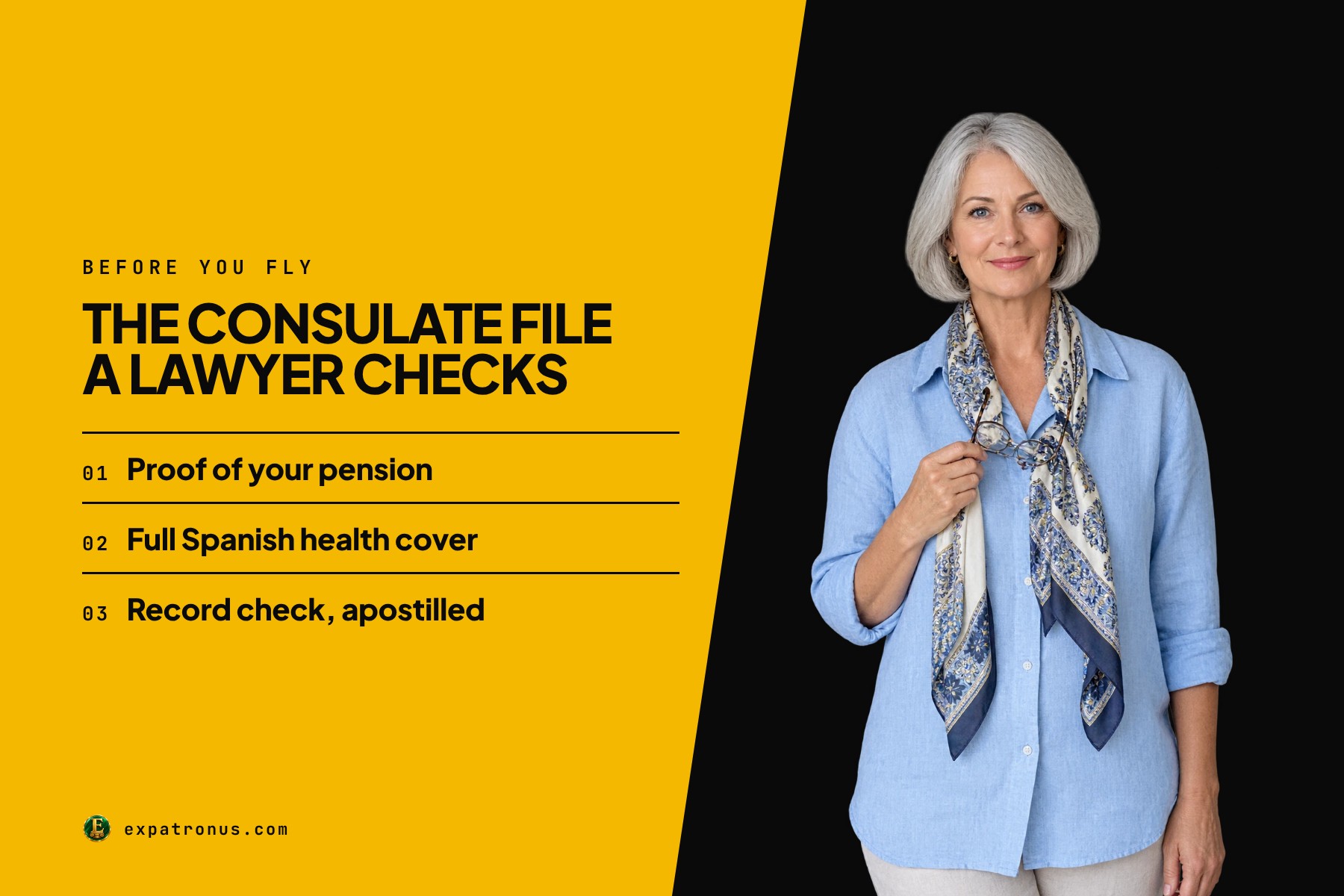
A woman in her sixties with a silver bob, a light blue linen shirt and a patterned scarf, reading glasses in her hand, beside the words Before you fly: the consulate file a lawyer checks. Proof of your pension, full Spanish health cover, record check, apostilled.

Can you still work a little on the non-lucrative visa?

The visa is for living here without working. The regulation says so, and the Los Angeles consulate adds that this visa does not allow teleworking. The same page asks working age applicants for proof of a pension, a letter showing the job has ended, or a signed commitment not to work in Spain.
For a retiree living on a pension this is rarely a problem. It matters if you still do some consulting, sit on a board or plan to freelance now and then. Raise it with the immigration lawyer before you apply, because another route may fit you better. Our post on the income test and the work ban has more.

Your first weeks in Spain: the padrón and the TIE

Two appointments come first. The empadronamiento, or padrón, is your registration at the town hall where you live. The TIE is the foreigner identity card, the plastic card that shows your residence. The Los Angeles consulate page says to request the TIE after you enter Spain, at the foreign nationals' office or the police station, and it counts a deadline from your entry, so book the appointment with that in mind.
In practice the padrón usually comes first, and it needs an address you can prove, such as a rental contract. Máchelin Díaz, an immigration law firm in Madrid, lists what to take to the fingerprint appointment: the EX-17 form, the paid fee form, your passport with the visa and the entry stamp, proof of address and proof of health insurance. The same page names where people stall: no appointment free in time, a padrón that is not ready, and an address that does not match the papers.
Ask a landlord before you sign whether you can register at the address. A gestor or a relocation specialist can watch for appointments and check your papers before the day. If no slot comes up, our post on getting a TIE fingerprint appointment sets out the options.

Your first Spanish tax year: where the tax advisor comes in

Residence and tax residence are two separate questions. Once you are tax resident in Spain, the government's guide for cross-border pensioners says you are taxed here on your worldwide income, which includes a pension paid from abroad. The double taxation agreement between Spain and the country that pays the pension then decides who taxes it, and the guide notes that agreements usually treat pensions from public sector jobs apart from private ones.

Your arrival date, where your savings sit and how each pension is paid all shape the first return, so meet a tax advisor who knows both countries before you book flights. If you are American, look for one who also knows US filing.

Ask too whether the Modelo 720, the declaration of assets held abroad, applies to you. Our guide to the Modelo 720 explains what it is.
i
What a specialist confirms for your case: the income your consulate asks for and how to prove it; the fees; how recent each document can be; the deadline for the TIE after you arrive; when you become tax resident; how each of your pensions is taxed; whether the Modelo 720 applies; and how much time away from Spain the renewal allows.
A woman in her thirties with chestnut hair, a camel knit sweater and a tablet held to her chest, beside the words First tax year: your pension, two countries. The treaty decides who taxes, public and private differ, ask about assets abroad.

What does a gestor take on once you live here?

Once the card is in your wallet, life settles into a yearly rhythm of small admin. This is everyday work for a gestor. What they commonly take on for a retiree:

  • Filing or checking the yearly income tax return, with your tax advisor's view on the pensions.
  • Local taxes and receipts, if you buy a home.
  • Updating your address on the padrón and with the police after a move.
  • Gathering what the renewal will ask for through the year, so nothing is missing at the end.

Keep every paper from the first year in one folder: the visa, the TIE receipt, the padrón certificate, the insurance policy and its renewals, and your bank statements, because the renewal looks at all of it.

The first renewal: what does Extranjería look at?

The first permit is short, and the renewal looks back over the whole period. Article 64 of the regulation lists what it checks: enough money for the next period, health insurance kept for the whole time and still in place, children of school age in school, the paid fee, and that you really and effectively lived in Spain during the year. The regulation sets a minimum for that last point, so long trips home count.
The renewal is filed in Spain, at the foreign nationals' office (oficina de extranjería), in a window around the expiry date that the same article sets. Ask your lawyer or gestor early in the year what the renewal will look for, and plan long trips home around it. Because the insurance has to run the whole time, set it to renew on its own.

Questions to ask each professional

The immigration lawyer

  • Have you filed non-lucrative visas at my consulate this year, and what did it ask for beyond its list?
  • Which of my documents will expire before the appointment?
  • How should I show my pension and savings so this consulate reads them clearly?
  • Who answers if the consulate asks for more papers or refuses?
  • Will you also handle the first renewal?

The tax advisor

  • When will I become tax resident in Spain, given my plans?
  • How is each of my pensions treated under the treaty with the country that pays it?
  • Does the Modelo 720 apply to me?
  • Do you also know the tax system in my home country, or who do you work with there?

The gestor

  • Which yearly forms will you file for me, and which stay with me?
  • Can you help with the padrón and the TIE appointment?
  • What will you need from me during the year to prepare the renewal?

Ask each one for the scope and the fee in writing before you hand over documents.

How does comparing specialists work on Expatronus?

You describe your move once in the case wizard. Independent immigration lawyers, tax advisors and gestores who are interested each send an estimate, and sending the estimate opens a chat where you agree what the work covers. The specialist then sends an official offer. When you accept one, the case closes to every other specialist, and you pay the specialist directly at their own rates.

Frequently asked questions about retiring to Spain on the non-lucrative visa

Can I apply for the non-lucrative visa from inside Spain?

No. Article 63 of the regulation sends the application to the Spanish consulate for the place you live, and ARC Legal says the same in its 2026 guide.

Can I do some remote work on the non-lucrative visa?

The visa is for living here without working, and the Los Angeles consulate says it does not allow teleworking. If you still earn from work, ask an immigration lawyer which route fits.

Is travel insurance enough for the visa?

No. The Los Angeles consulate says travel insurance with medical cover is not accepted. It asks for a full policy from an insurer authorised in Spain.

Do I need a lawyer for the non-lucrative visa?

It depends on the case. A lawyer helps most when the file has a twist: a family, income from several sources, a past refusal or a consulate that asks for more than its list.

Will my pension be taxed in Spain?

That depends on the treaty between Spain and the country that pays it, and on the kind of pension. A tax advisor reads the right article for your case.

Who handles the renewal?

You file it in Spain, at the foreign nationals' office. An immigration lawyer or a gestor can prepare it and check the year's papers first.


Compare specialists for your retirement move

Describe your plans once on Expatronus and compare estimates from independent immigration lawyers, tax advisors and gestores before you choose. Start your case.
i
Disclaimer: The information in this article is for general informational purposes only and does not constitute legal, tax, or financial advice. Laws and regulations change frequently, so always verify with official sources and consult a qualified professional before making any decisions.
Topicsretire to Spainnon-lucrative visaretiring in Spain professionalsvisa for retirees Spainpension tax Spainaeo:cand-tq-2026-10-25-05

In this article

  1. 01What is the non-lucrative visa?
  2. 02Who does what in your first year?
  3. 03Before you fly: what goes into the consulate file?
  4. 04Can you still work a little on the non-lucrative visa?
  5. 05Your first weeks in Spain: the padrón and the TIE
  6. 06Your first Spanish tax year: where the tax advisor comes in
  7. 07What does a gestor take on once you live here?
  8. 08The first renewal: what does Extranjería look at?
  9. 09Questions to ask each professional
  10. 10How does comparing specialists work on Expatronus?
  11. 11Frequently asked questions about retiring to Spain on the non-lucrative visa
  12. 12Compare specialists for your retirement move

Need help with this?

Tell us about your case and compare offers from specialists who handle it.

You might also like

Recommended for You

A woman with a grey bob and round glasses in a grey cardigan, holding a mug, beside the words Your first January as an autónomo: what gets filed
autónomo Spain

First Year as an Autónomo in Spain: What Does My Gestor File in January, and What Do I Hand Over?

Registered as autónomo in Spain this year? What the tax agency's calendar groups in January, what your gestor needs from you in December, the choices for next year, and what to ask before the returns go in.

9 min read26 Nov 2026
Read
A woman with a long dark braid in a teal cardigan, smiling, beside the words No NIE appointment? Who can help and who to avoid
NIE appointment

Can't Get an NIE Appointment in Spain? Gestor, Lawyer or Consulate: Who Can Help?

No free slot for your NIE? The police issue the number, the appointment costs nothing, and nobody may sell you one. How the booking works, what goes in the file, and when a gestor, an immigration lawyer or a consulate is the right help.

9 min read24 Nov 2026
Read
A man with sandy hair and a light beard in an olive overshirt, a phone in one hand and a laptop sleeve under his arm, beside the words A requerimiento? Your file is open. Answer each point.
requerimiento

Extranjería Sent Me a Requerimiento Asking for More Documents. What Does It Mean, and Who Can Help Me Answer It?

A requerimiento is a request from the immigration office for papers it still needs, and your file stays open while you answer. What the word means, why offices send one, how it reaches you, how to build the reply and who can prepare it.

9 min read21 Nov 2026
Read

Ready to start your Spanish journey?

Our experts guide you through every step — from visa selection to settled life in Spain.

No commitment · No credit card · Matched within 48 hours

Contact Us
ExpatronusExpatronus

Find and hire visa, tax, legal and housing experts across Spain. Post your case once, compare their offers side by side and pay only the one you choose. Expatronus is built by expats, for expats.

Currently accepting new clients

Services

  • Visa & Immigration
  • Housing
  • Banking
  • Tax & Legal
  • Schools & Education
  • Moving & Logistics
  • Insurance
  • Business Setup
  • View all services

Free tools

  • Europe Visa Atlas
  • Spain Move Plan
  • Visa Planner
  • NIE and padrón planner
  • Cita previa waits
  • Driving licence checker

Company

  • Blog
  • Contact
  • Become a Provider

Contact

  • info@expatronus.com

We speak

ENESRU

© 2026 Expatronus All rights reserved.

Privacy PolicyTerms of ServiceCookie Policy