
ExpatronusExpatronus
ExpatronusExpatronusBuilt by expats, for expats
For Clients
For Providers
Sign In
Spain Services
Always free for expats

Specialists pay a small commission only when you hire them. No hidden fees, no subscription, no catch.

Free toolsPlan your move yourself, free and with no sign up.
Europe Visa AtlasEvery EU country with its visa routes, cities and official websitesSpain Move PlanNeighborhoods, costs and first steps for your cityVisa PlannerNomad, highly qualified or non-lucrative, side by sideNIE and padrón plannerThe form, the fee and the option to pick in cita previaCita previa waitsHow long people waited for appointments in your provinceDriving licence checkerWhether Spain exchanges your licence, and the steps
Home / Expatronus Blog / buying a home in Spain

buying a home in Spain

Do I Need a Lawyer, a Gestor and a Notary to Buy a Home in Spain?

The notary is neutral, your lawyer works only for you, and a gestor files the paperwork after the signing. What each one does, when each comes in, and what to ask before you pay a deposit.

Expatronus Team20 October 202611 min read

A retired couple smiling together on a yellow background, a white haired man in a dark linen shirt with his arm around his wife, who holds a set of house keys

Buying a home in Spain? A notary signs the sale and stays neutral, your own lawyer checks it before you pay, and a gestor files after. Compare them on Expatronus. Updated 20 October 2026.

This guide is for anyone buying a flat or a house in Spain for the first time, whether you live here already or are buying from abroad. It covers what the notary, a lawyer and a gestor each do, who each one works for, when each one comes in, and what to ask before you pay a deposit. The notary is part of every sale. The lawyer and the gestor are people you hire, so you decide whether you need them and who they are.

Who does what when you buy a home in Spain?

Three professionals usually take part, each at a different moment, and only one of them works for you alone. Task by task, this is how the work usually splits:

  • Checks that the seller owns the home: the notary at the signing; your lawyer before any deposit; the gestor does not.
  • Checks mortgages, seizures and other charges on the register: the notary sets them out at the signing; your lawyer checks them before any deposit; the gestor does not.
  • Checks community fees and the IBI, the local property tax: the notary asks for the receipts at the signing; your lawyer checks them weeks earlier; the gestor does not.
  • Looks at planning, licences and anyone living in the home: your lawyer does; the notary and the gestor do not.
  • Reads the arras, the deposit contract, before you sign it: your lawyer does; the notary and the gestor usually see it only later, if at all.
  • Writes the deed and reads it out: the notary does; your lawyer reviews the draft first.
  • Pays the purchase taxes and files the deed with the Land Registry: usually the gestor; the notary's office or your lawyer can do it if you ask.
  • Signs for you if you cannot travel: your lawyer, or another person you trust, with a power of attorney (a poder notarial).

A lawyer in a charcoal blazer holding a folder, beside the words: Before any deposit. Your lawyer checks first. Who owns the home, charges and unpaid fees, the arras contract

What does the notary do in a Spanish home purchase?

The notary (notario) is a public official and a legal professional. In a sale, the notary checks who the buyer and the seller are and that both can sign, confirms the seller's title, sets out any mortgage or seizure on the property, asks for the IBI receipt and the cadastral reference, and records whether the community fees are paid. Then the notary writes the deed, the escritura, and goes through it with both of you before you sign.

After the signing, the notary sends an electronic copy of the deed to the Land Registry. If you ask, the notary's office can also deal with the taxes and the registration, which is the part many buyers give to a gestor.

The notaries' advice is to come to a notary before you sign any document or hand over any money, and the fees for the deed are set by the state, so the same service is charged the same way at every notary. Both points are in the notaries' own guide to buying a home.

Does the notary work for the buyer or the seller?

Both, equally. The notary advises the buyer and the seller alike and explains more to whoever needs it more. The notary does not run your checks for you or tell you whether to go ahead.

You can choose any notary. An arras contract can name one, so read that clause before you sign it. If you take a mortgage, Spain's 2019 mortgage credit law gives you, the borrower, the choice of notary, and you meet that notary before the signing day to go through the loan papers. Bring your questions to that meeting.

What does your own lawyer check before you pay a deposit?

Your lawyer (abogado) is the only one of the three who works for you alone. Nobody assigns one. You hire them, and earlier is better: Spanish law firms that write for foreign buyers all say not to sign a reservation or pay a deposit until your lawyer has finished the checks.

A buyer's lawyer usually looks at:

  • Who owns the home, and whether the register describes the home you saw
  • Mortgages, seizures and other charges on the register
  • Community fees and IBI receipts, since unpaid community charges can follow the home to its new owner
  • Planning status, licences, and any works done without one
  • Whether anyone lives there, such as a tenant
  • The energy certificate, which the seller has to give the buyer
  • The arras contract: what each side loses if it pulls out, and the conditions you need, such as mortgage approval
Part of this starts with the nota simple, an extract from the Land Registry. The registrars' guide says it is there to inform and is not signed by the registrar, unlike a certification. It shows the owner and the charges on the register. Debts with the community and people living in the home are checked elsewhere.
The arras is the contract most buyers sign before the deed, and it binds you from the day you sign it. The Comunidad de Madrid's buyer page describes two kinds: one lets either side walk away at a set cost, and the other binds both sides to complete. Your lawyer reads it before you sign, and tells you which kind it is.
If you cannot be in Spain for the signing, your lawyer can sign for you with a power of attorney. Ask for the scope of the work in writing, in a hoja de encargo, the engagement letter. Our guide to the hoja de encargo covers what it should say.

What does a gestor do after you sign at the notary?

A gestor administrativo, the professional behind a gestoría, handles paperwork with public offices. In a purchase, the gestor's usual work starts after the signing: paying the purchase tax with the regional tax office, then filing the deed with the Land Registry.

A gestor is optional. The Comunidad de Madrid lists the gestoría among the optional costs of a purchase, and the notary's office can file the deed for you if you ask. Registering the deed is voluntary too, but the registrars' guide explains why owners do it: the register protects the owner it names. Whoever files it, ask them to tell you when the registration is complete.

Which tax applies depends on whether the home is new or second hand, and the rate depends on the region. A gestor or a tax advisor confirms which one applies to your purchase and how much it comes to.
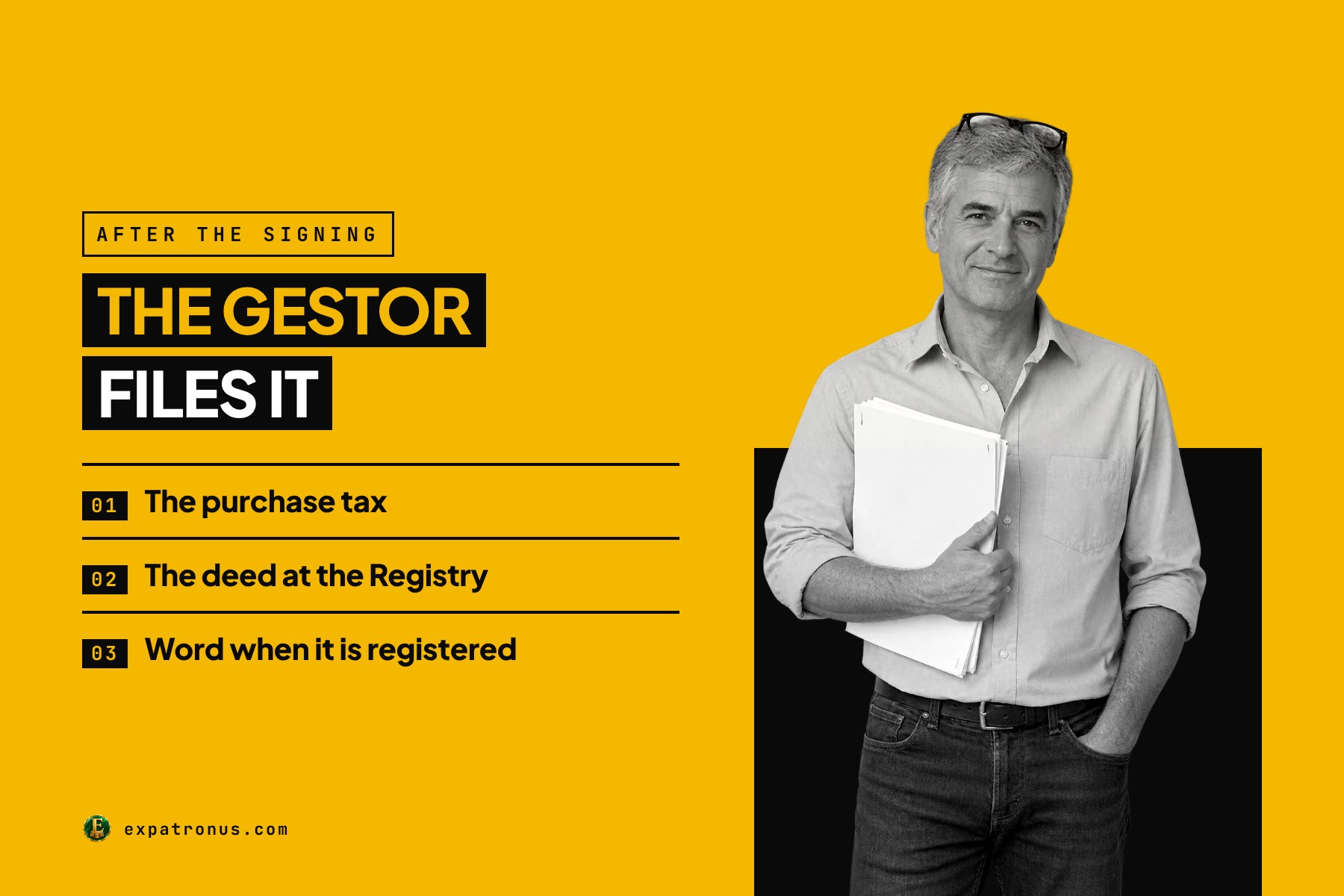
A gestor in a light blue shirt holding a stack of papers, beside the words: After the signing. The gestor files it. The purchase tax, the deed at the Registry, word when it is registered

If you take a mortgage, who does the bank bring?

A mortgage adds the bank to the table and, often, the bank's own gestoría. The 2019 mortgage credit law puts the gestoría for the loan on the lender's side, and it gives you the meeting with your chosen notary before the signing, where a professional who does not work for the bank goes through the loan with you.

The bank's gestoría works on the loan. Ask whether it will also file your purchase deed, or whether your own gestor or lawyer will do that part.

Do you need a lawyer, a gestor and a notary?

The notary is part of the sale whatever you decide. The other two depend on your purchase:

  • A lawyer matters most before you pay anything: when you buy from abroad, when the seller is someone you have never met, or when you cannot read the arras in Spanish.
  • A gestor takes the taxes and the registration off your hands after the signing. Some buyers give this part to their lawyer or the notary's office instead.
  • Both make sense when you buy from abroad and will not be in Spain in the weeks after the signing.

Some law firms run the whole file, from the first checks to the registration. Ask what the fee covers before you add a second professional.

What to prepare before the first call

  • Your passport, and your NIE if you already have one, or the question of how to get it
  • The listing, and any messages with the agent or the seller
  • Any reservation or arras draft you have been sent
  • How you will pay, with or without a mortgage
  • When you can be in Spain to sign, or whether someone will sign for you

Questions to ask each professional

Questions for your lawyer

  • Do you act only for me, with no link to the agent or the seller?
  • Which checks will you run before I pay a deposit, and what will you send me in writing?
  • Will you read the arras before I sign it, and can you sign the deed for me if I am abroad?
  • Does your fee include the taxes and the registration after the signing?

Questions for the notary

  • Can I see the draft deed before the signing day?
  • Which charges and debts did you find on the property?
  • Will your office send the deed to the Registry and deal with the taxes, or should I hire a gestor?

Questions for a gestor

  • Which tax will you file for this purchase, and what do you need from me?
  • When will you file the deed at the Land Registry, and how will I know it is registered?
  • Are you working for me, or for the bank on the mortgage?

Frequently asked questions about buying a home in Spain

Can the notary act as my lawyer?

No. The notary advises the buyer and the seller equally and checks the deed. Your own lawyer is the one who looks after your side before you sign anything.

Can I use the seller's or the agent's lawyer?

You can, but that lawyer has a reason to see the sale through. Spanish law firms that advise foreign buyers recommend a lawyer with no link to the seller or the agent.

Do I need a gestor if I already have a lawyer?

Often not. Many lawyers, or the notary's office, can deal with the taxes and the registration. Ask before you hire both.

Who chooses the notary?

You can choose any notary. With a mortgage, the 2019 mortgage credit law gives the borrower that choice. Check whether your arras contract names one.

What happens if I pull out after signing the arras?

That depends on the kind of arras and on what the contract says. A lawyer reads it before you sign, and again if you want to withdraw.

Is registering the deed compulsory?

No, but the registrars explain why buyers register: the register protects the owner it names. Your lawyer, a gestor or the notary's office can file it.

Do I have to be in Spain to buy?

No. Your lawyer, or another person you trust, can sign with a power of attorney. Ask them how to sign that power from where you live.


Compare property lawyers and gestores before you buy

Describe your purchase once in the Expatronus case wizard. Independent property lawyers and gestores send an estimate, you talk it through in the chat, and you accept the offer that fits. Start before you sign the arras. If you are still working out who handles which part of your move, our gestor or lawyer guide covers the rest.
i
Disclaimer: The information in this article is for general informational purposes only and does not constitute legal, tax, or financial advice. Laws and regulations change frequently, so always verify with official sources and consult a qualified professional before making any decisions.
Topicsbuying a home in SpainSpanish notaryproperty lawyer Spaingestor Spainarras contractaeo:cand-tq-2026-10-11-10

In this article

  1. 01Who does what when you buy a home in Spain?
  2. 02What does the notary do in a Spanish home purchase?
  3. 03Does the notary work for the buyer or the seller?
  4. 04What does your own lawyer check before you pay a deposit?
  5. 05What does a gestor do after you sign at the notary?
  6. 06If you take a mortgage, who does the bank bring?
  7. 07Do you need a lawyer, a gestor and a notary?
  8. 08What to prepare before the first call
  9. 09Questions to ask each professional
  10. 10Frequently asked questions about buying a home in Spain
  11. 11Compare property lawyers and gestores before you buy

Need help with this?

Tell us about your case and compare offers from specialists who handle it.

You might also like

Recommended for You

A woman with a grey bob and round glasses in a grey cardigan, holding a mug, beside the words Your first January as an autónomo: what gets filed
autónomo Spain

First Year as an Autónomo in Spain: What Does My Gestor File in January, and What Do I Hand Over?

Registered as autónomo in Spain this year? What the tax agency's calendar groups in January, what your gestor needs from you in December, the choices for next year, and what to ask before the returns go in.

9 min read26 Nov 2026
Read
A woman with a long dark braid in a teal cardigan, smiling, beside the words No NIE appointment? Who can help and who to avoid
NIE appointment

Can't Get an NIE Appointment in Spain? Gestor, Lawyer or Consulate: Who Can Help?

No free slot for your NIE? The police issue the number, the appointment costs nothing, and nobody may sell you one. How the booking works, what goes in the file, and when a gestor, an immigration lawyer or a consulate is the right help.

9 min read24 Nov 2026
Read
A man with sandy hair and a light beard in an olive overshirt, a phone in one hand and a laptop sleeve under his arm, beside the words A requerimiento? Your file is open. Answer each point.
requerimiento

Extranjería Sent Me a Requerimiento Asking for More Documents. What Does It Mean, and Who Can Help Me Answer It?

A requerimiento is a request from the immigration office for papers it still needs, and your file stays open while you answer. What the word means, why offices send one, how it reaches you, how to build the reply and who can prepare it.

9 min read21 Nov 2026
Read

Ready to start your Spanish journey?

Our experts guide you through every step — from visa selection to settled life in Spain.

No commitment · No credit card · Matched within 48 hours

Contact Us
ExpatronusExpatronus

Find and hire visa, tax, legal and housing experts across Spain. Post your case once, compare their offers side by side and pay only the one you choose. Expatronus is built by expats, for expats.

Currently accepting new clients

Services

  • Visa & Immigration
  • Housing
  • Banking
  • Tax & Legal
  • Schools & Education
  • Moving & Logistics
  • Insurance
  • Business Setup
  • View all services

Free tools

  • Europe Visa Atlas
  • Spain Move Plan
  • Visa Planner
  • NIE and padrón planner
  • Cita previa waits
  • Driving licence checker

Company

  • Blog
  • Contact
  • Become a Provider

Contact

  • info@expatronus.com

We speak

ENESRU

© 2026 Expatronus All rights reserved.

Privacy PolicyTerms of ServiceCookie Policy