
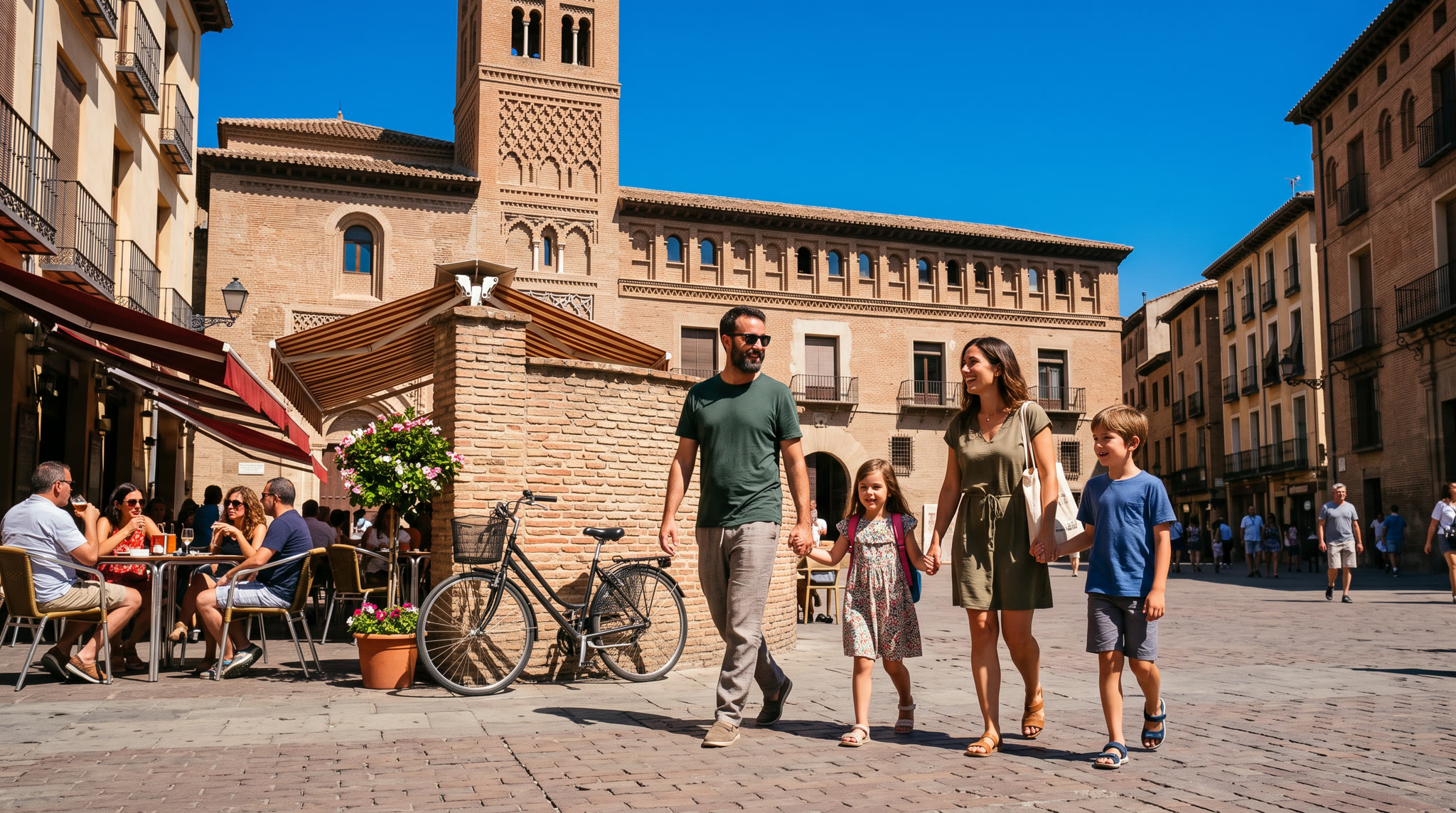
Where to Live in Zaragoza: Seven Districts and the Trade-off Behind Each
Expatronus Team26 August 20268 min de lectura
Centro, Casco Histórico, Universidad, Delicias, La Almozara, Actur-Rey Fernando and the Distrito Sur. What each district is actually like to live in, where it sits on price in 2026, and the catch nobody mentions on the viewing.
Zaragoza is the fifth largest city in Spain and the one that people moving here research last. That is a shame, because it is also the city where the distance between the most expensive district and the cheapest is small enough that you can choose on how you want to live rather than on what you can just about afford. The Ebro runs west to east and splits the city unevenly: almost everything central sits on the south bank, while the north bank holds El Rabal and Actur-Rey Fernando. The Ayuntamiento divides the municipality into fifteen urban districts, each with its own Junta Municipal (district council), plus fourteen barrios rurales (rural villages) that belong to the city administratively but sit well outside it. The municipal register counted 727,475 residents in October 2025, of whom 16.8% were foreign nationals. This is a guide to seven of those districts, for someone who has picked the city and now has to pick a street.
One number is worth fixing before you look at anything else. In July 2026, idealista put the average asking price for a home in Zaragoza at €2,350 per square metre, up 11.5% on the year before. Those are sale prices rather than rents, and they are used here because they are the figures published district by district with a date attached, which monthly rents for this city are not. They will not tell you what you pay each month. What they do give you is the ranking, and the gap between the priciest zone and the cheapest is roughly double, which for a Spanish provincial capital is narrow. In Zaragoza the district you choose changes your commute and your evenings far more than it changes your budget.
Centro and Casco Histórico: both central, not remotely alike
Centro is the most expensive part of the city, at €3,077 per square metre in July 2026. What you are buying is the Paseo de la Independencia and Gran Vía, the wide nineteenth century boulevards that carry the shops, the cinemas and the tram, and the fact that you will not need transport for anything at all. It suits someone who works centrally, wants to walk everywhere, and has decided the premium is worth paying. The trade-off is the ordinary one and it rarely surprises anybody: you pay more per square metre for less floor, and the buildings are older than the price implies.
Casco Histórico is next door, older still, and cheaper, and it is the one district where the building matters far more than the postcode. It holds the Mercado Central, the restored covered market on Avenida de César Augusto, which reopened in February 2020 after a restoration of almost three years and now runs 74 food stalls plus four hospitality spaces, open Monday to Friday from 9am to 2pm and 5.30pm to 8pm and on Saturday mornings, as listed in August 2026. It also holds El Tubo, the knot of alleys off Plaza España made up of Mártires, Cuatro de Agosto, Cinegio, Libertad and Estébanes, where the bars have historically each specialised in one tapa rather than competing across a menu. Now the honest part. The city runs a standing regeneration programme here, the Plan Integral del Casco Histórico, and the council's own documents name housing quality and social problems as the district's central concerns. Streets change character block by block. View in the evening as well as in daylight, and read the stairwell as carefully as the flat.

Universidad: the largest flats in the city, and a building site until 2027
Universidad is reliably the second priciest district after Centro, with the Universidad-San Francisco zone at €2,845 per square metre in July 2026. It wraps around the Campus San Francisco, the University of Zaragoza's main city campus, and its real selling point is unusual in Spain: the flats are big. The blocks that went up along Gran Vía and Fernando el Católico in the mid twentieth century were built with four and five bedrooms as standard, which is why families who would otherwise be pushed to the edge of the city stay put here. Parque Grande José Antonio Labordeta sits on the southern edge, laid out between 1913 and 1927 and opened in 1929, with a botanical garden dating back to 1796 and a 1,500 metre running track. The catch is easy to miss on a video viewing: the Romareda stadium is being rebuilt. The contract for the main build went to a consortium led by OHLA for €124.5 million excluding VAT, the works are targeted to finish before the summer of 2027, and the surrounding streets are being re-urbanised on roughly the same timetable. Sign a lease beside it during 2026 and you are signing beside a construction site.
Delicias: the biggest district in the city, and the best value close in
Delicias counted 102,595 residents on 1 January 2025, which makes it comfortably the most populous district in Zaragoza and one of the densest urban areas anywhere in Spain. It grew in the middle of the last century as housing for industrial workers and still looks like it: long blocks from the 1960s, narrow pavements, a business behind every ground floor door. It is also the most international part of the city by a wide margin, with close to three in ten residents born outside Spain, and that turns up as a genuinely useful high street rather than as a statistic. Estación Zaragoza-Delicias, opened in 2003, sits on the western edge, and it is why the district deserves a look from anyone who travels for work: high speed and long distance trains, the Cercanías line and the whole intercity bus station under one roof. The trade-off is the housing stock, not the neighbourhood. Plenty of blocks predate lifts, and a fourth floor in Delicias can mean four flights with the shopping. Ask before you view.
La Almozara and Actur-Rey Fernando: the two river districts
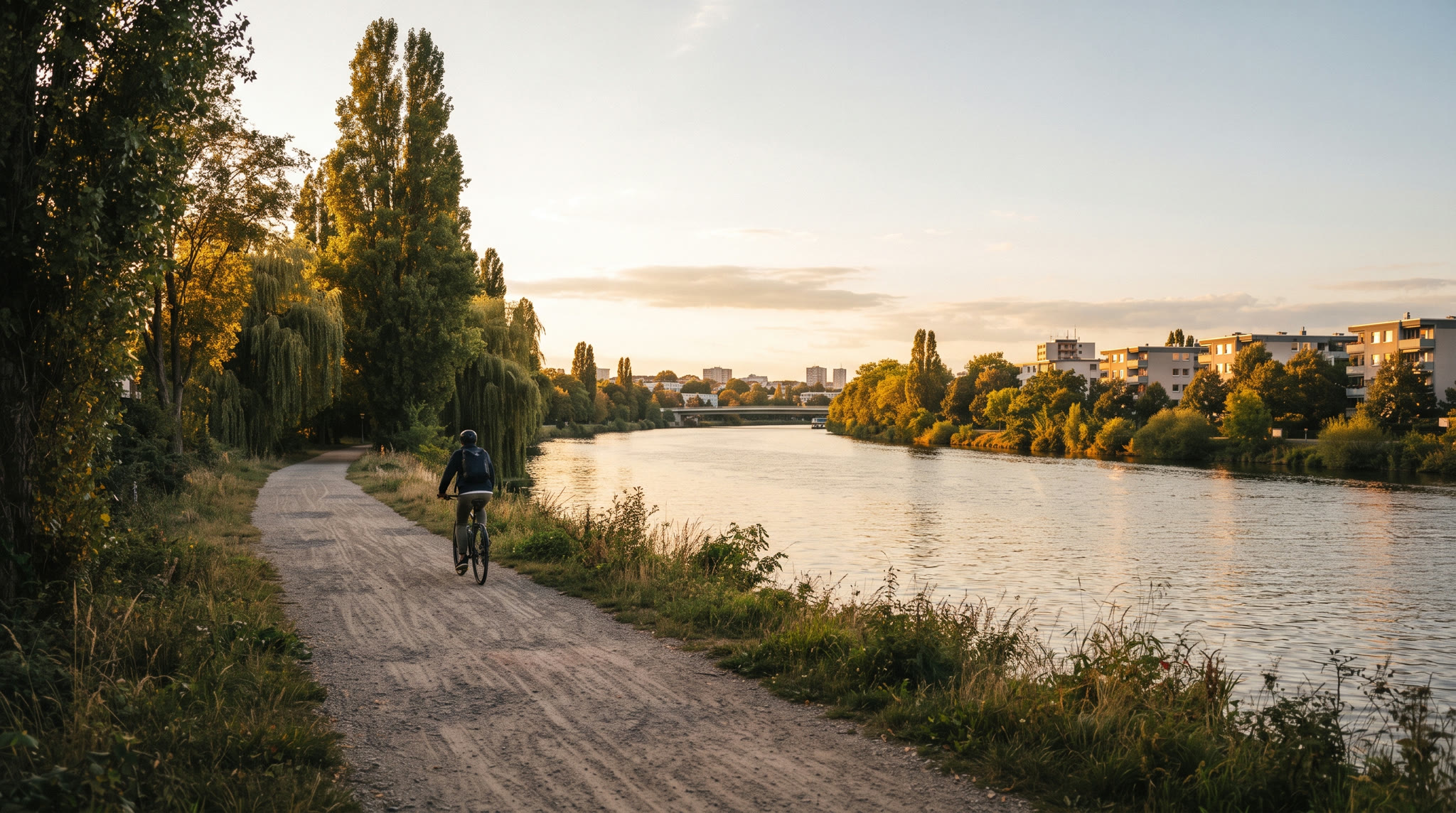
La Almozara is the small district wedged between the Ebro, Delicias and the centre. It was industrial until the end of the 1970s and has spent the decades since becoming residential with the riverbank as its front garden, which is why it is the usual answer for someone who wants to walk into the centre without paying Centro prices. It is small, so the stock is limited and the good flats go quickly. Across the water, Actur-Rey Fernando is its opposite: planned, uniform and large, with 55,535 residents at the start of 2025. The name is an acronym for Actuaciones Urbanísticas Urgentes, urgent urban works, which tells you plainly what it was thrown up for in the 1970s. The tram reached it in 2013 and changed the place. Its argument for a family is the Parque del Agua Luis Buñuel, more than 120 hectares in the Ranillas meander of the Ebro, the largest urban park in the city, left behind by Expo 2008 and carrying running circuits of 5 and 10 kilometres. The trade-off is as much psychological as practical: you are on the far bank, and people who live south of the river cross it less often than the map suggests they would.
Distrito Sur: newest, furthest out, cheapest to buy into
The Distrito Sur was carved out of Casablanca in 2018 and covers Valdespartera, Montecanal, Rosales del Canal and Arcosur. Valdespartera was built to bioclimatic criteria, with block heights and orientations chosen for solar gain, along with solar panels and pneumatic waste collection, and it is the southern terminus of the tram. Arcosur is the city's still unfinished expansion, planned for around 21,000 homes of which roughly 4,205 have been built or have licences granted or applied for. Almost everything here is new, which for a family arriving from northern Europe usually means the flat behaves the way you expect: a lift, insulation that works, parking, a school within walking distance. What you give up is the thing that makes Zaragoza pleasant in the first place, which is being able to walk into the middle of it. The tram is the compensation and it is a real one, but you are commuting.
Getting around, and two things that catch people out
- Tram line 1 is the spine of the city, and there is only one line. It runs north to south from Valdespartera to Parque Goya, straight through the centre. A flat near it is worth real money, and a flat far from it costs you time every day.
- Cercanías line C1 is the only commuter rail line, running from Casetas in the west to Miraflores in the east, calling at Utebo, Delicias, Portillo and Goya. The council puts it at every five minutes at peak and every thirty off peak.
- Bizi Zaragoza, the municipal bike share, is now pedal-assist, and the city recorded 11,354,839 trips in its first full year to July 2026, an average of 20,953 a day. Zaragoza is flat, which is exactly why this works here and does not everywhere.
- The Canal Imperial de Aragón, an eighteenth century canal, runs through Casablanca, Torrero and La Paz and doubles as a walking and cycling corridor. The municipal route along it from Torrero to La Cartuja Baja is 6.8 kilometres.
The first thing that catches people out is the cierzo, the dry north westerly wind that dominates Zaragoza's weather. It is why the winters feel colder than the thermometer claims, and why the summer heat is survivable in a way that coastal humidity is not. It also quietly decides which side of a building you want to be on, so ask which way a flat faces before you fall for the light in the photographs. The second is the Fiestas del Pilar, held every October across roughly ten days around the 12th. The Ofrenda de Flores on 12 October and the Rosario de Cristal the following evening fill the centre, around nine in ten events are free and outdoors, and if you live in Casco Histórico or Centro you are not watching it, you are in it. Some people move partly for that week. Others learn to book a trip away.
⚠️The most useful habit when flat hunting here: ask about the lift, the glazing and the orientation before you ask about the district. A well insulated third floor with a lift in Delicias will make for a better year than a fourth floor walk up in Centro, and it will cost you less every month.
💡
Before you go: opening hours, prices and festival dates change, and places close — everything here was checked when this article was written, but it is always worth confirming directly before you make the trip. Planning a move to Spain? We can match you with specialists who know the city.
💡
Disclaimer: The information in this article is for general informational purposes only and does not constitute legal, tax, or financial advice. Laws and regulations change frequently — always verify with official sources and consult a qualified professional before making any decisions. Contact our specialists or start your free assessment for personalised guidance.
También te puede gustar
Recomendado para ti
8 min de lectura
School Enrolment in Spain: the Points Race in March, the Capacity Queue in September
A school place in Spain is guaranteed. The school is not. Admission is decided by a points score in a spring window that closes six months before term, and arriving later puts you on a different route entirely.
Expatronus Team3 Sept 2026
Leer

8 min de lectura
Health Insurance for a Spanish Visa: The Four Conditions That Decide It
Most rejected insurance certificates fail on one of four things: the insurer, a copayment, a waiting period, or the dates. Here is what a Spanish consulate is checking, plus the two public routes and what cover actually costs.
Expatronus Team2 Sept 2026
Leer
8 min de lectura
Where to Live in Sevilla: A Barrio Guide for People Who Are Actually Moving
Eight Sevilla districts, what each one is really for, and what you give up by choosing it. With August 2026 prices, the noise register, the tourist licence cap and the walk to the metro.
Expatronus Team2 Sept 2026
Leer
¿Listo para empezar tu
aventura española?
Nuestros expertos te guían en cada paso, desde la selección del visado hasta asentarte en España.
Sin compromiso · Sin tarjeta de crédito · Resultados en 24 horas