
Buying a home in Spain? A notary signs the sale and stays neutral, your own lawyer checks it before you pay, and a gestor files after. Compare them on Expatronus. Updated 20 October 2026.
This guide is for anyone buying a flat or a house in Spain for the first time, whether you live here already or are buying from abroad. It covers what the notary, a lawyer and a gestor each do, who each one works for, when each one comes in, and what to ask before you pay a deposit. The notary is part of every sale. The lawyer and the gestor are people you hire, so you decide whether you need them and who they are.
Who does what when you buy a home in Spain?
Three professionals usually take part, each at a different moment, and only one of them works for you alone. Task by task, this is how the work usually splits:
- Checks that the seller owns the home: the notary at the signing; your lawyer before any deposit; the gestor does not.
- Checks mortgages, seizures and other charges on the register: the notary sets them out at the signing; your lawyer checks them before any deposit; the gestor does not.
- Checks community fees and the IBI, the local property tax: the notary asks for the receipts at the signing; your lawyer checks them weeks earlier; the gestor does not.
- Looks at planning, licences and anyone living in the home: your lawyer does; the notary and the gestor do not.
- Reads the arras, the deposit contract, before you sign it: your lawyer does; the notary and the gestor usually see it only later, if at all.
- Writes the deed and reads it out: the notary does; your lawyer reviews the draft first.
- Pays the purchase taxes and files the deed with the Land Registry: usually the gestor; the notary's office or your lawyer can do it if you ask.
- Signs for you if you cannot travel: your lawyer, or another person you trust, with a power of attorney (a poder notarial).

What does the notary do in a Spanish home purchase?
After the signing, the notary sends an electronic copy of the deed to the Land Registry. If you ask, the notary's office can also deal with the taxes and the registration, which is the part many buyers give to a gestor.
Does the notary work for the buyer or the seller?
Both, equally. The notary advises the buyer and the seller alike and explains more to whoever needs it more. The notary does not run your checks for you or tell you whether to go ahead.
What does your own lawyer check before you pay a deposit?
A buyer's lawyer usually looks at:
- Who owns the home, and whether the register describes the home you saw
- Mortgages, seizures and other charges on the register
- Community fees and IBI receipts, since unpaid community charges can follow the home to its new owner
- Planning status, licences, and any works done without one
- Whether anyone lives there, such as a tenant
- The energy certificate, which the seller has to give the buyer
- The arras contract: what each side loses if it pulls out, and the conditions you need, such as mortgage approval
What does a gestor do after you sign at the notary?
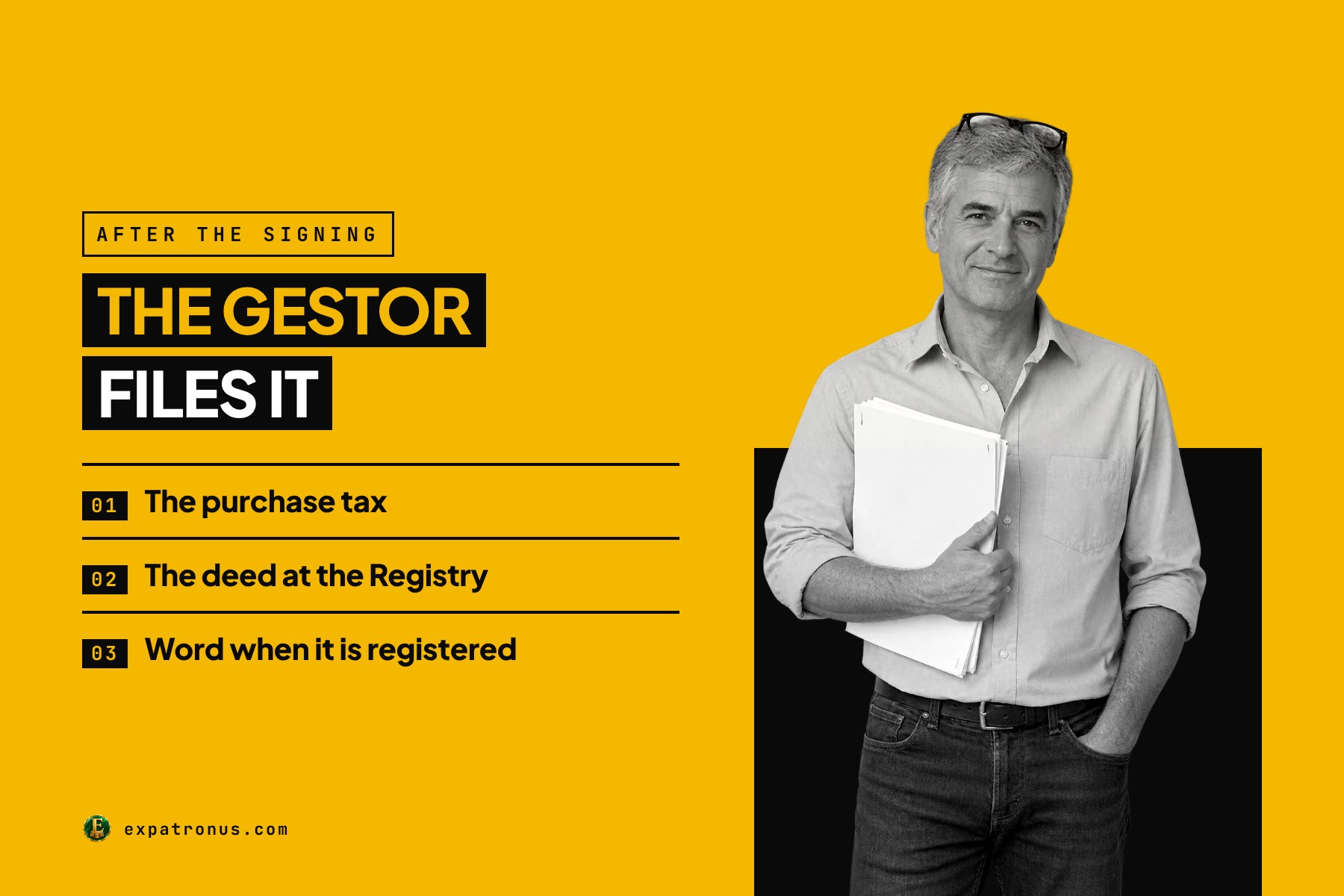
A gestor is optional. The Comunidad de Madrid lists the gestoría among the optional costs of a purchase, and the notary's office can file the deed for you if you ask. Registering the deed is voluntary too, but the registrars' guide explains why owners do it: the register protects the owner it names. Whoever files it, ask them to tell you when the registration is complete.
Which tax applies depends on whether the home is new or second hand, and the rate depends on the region. A gestor or a tax advisor confirms which one applies to your purchase and how much it comes to.
If you take a mortgage, who does the bank bring?
A mortgage adds the bank to the table and, often, the bank's own gestoría. The 2019 mortgage credit law puts the gestoría for the loan on the lender's side, and it gives you the meeting with your chosen notary before the signing, where a professional who does not work for the bank goes through the loan with you.
The bank's gestoría works on the loan. Ask whether it will also file your purchase deed, or whether your own gestor or lawyer will do that part.
Do you need a lawyer, a gestor and a notary?
The notary is part of the sale whatever you decide. The other two depend on your purchase:
- A lawyer matters most before you pay anything: when you buy from abroad, when the seller is someone you have never met, or when you cannot read the arras in Spanish.
- A gestor takes the taxes and the registration off your hands after the signing. Some buyers give this part to their lawyer or the notary's office instead.
- Both make sense when you buy from abroad and will not be in Spain in the weeks after the signing.
Some law firms run the whole file, from the first checks to the registration. Ask what the fee covers before you add a second professional.
What to prepare before the first call
- Your passport, and your NIE if you already have one, or the question of how to get it
- The listing, and any messages with the agent or the seller
- Any reservation or arras draft you have been sent
- How you will pay, with or without a mortgage
- When you can be in Spain to sign, or whether someone will sign for you
Questions to ask each professional
Questions for your lawyer
- Do you act only for me, with no link to the agent or the seller?
- Which checks will you run before I pay a deposit, and what will you send me in writing?
- Will you read the arras before I sign it, and can you sign the deed for me if I am abroad?
- Does your fee include the taxes and the registration after the signing?
Questions for the notary
- Can I see the draft deed before the signing day?
- Which charges and debts did you find on the property?
- Will your office send the deed to the Registry and deal with the taxes, or should I hire a gestor?
Questions for a gestor
- Which tax will you file for this purchase, and what do you need from me?
- When will you file the deed at the Land Registry, and how will I know it is registered?
- Are you working for me, or for the bank on the mortgage?
Frequently asked questions about buying a home in Spain
Can the notary act as my lawyer?
No. The notary advises the buyer and the seller equally and checks the deed. Your own lawyer is the one who looks after your side before you sign anything.
Can I use the seller's or the agent's lawyer?
You can, but that lawyer has a reason to see the sale through. Spanish law firms that advise foreign buyers recommend a lawyer with no link to the seller or the agent.
Do I need a gestor if I already have a lawyer?
Often not. Many lawyers, or the notary's office, can deal with the taxes and the registration. Ask before you hire both.
Who chooses the notary?
You can choose any notary. With a mortgage, the 2019 mortgage credit law gives the borrower that choice. Check whether your arras contract names one.
What happens if I pull out after signing the arras?
That depends on the kind of arras and on what the contract says. A lawyer reads it before you sign, and again if you want to withdraw.
Is registering the deed compulsory?
No, but the registrars explain why buyers register: the register protects the owner it names. Your lawyer, a gestor or the notary's office can file it.
Do I have to be in Spain to buy?
No. Your lawyer, or another person you trust, can sign with a power of attorney. Ask them how to sign that power from where you live.